An AI tools directory that Microsoft Copilot cites roughly a hundred times for every organic click it sends, across 1,640 grounding queries, in five languages, with 52% of those citations on commercial-intent searches. One page alone has been cited 108,546 times. This is what it looks like when the answer engine becomes the audience.
This site earns 1,952 clicks (a fraction of the others) and yet 8.1% of its search impressions come from Google AI features, five times the rate of the largest property. It also holds 200 of 1,000 queries in the top three. The data points to specificity rather than scale, though a single property cannot isolate the variable.
87% of this platform’s AI appearances land on one URL, and Copilot cites an average of 2 pages against 35 on my city-guide property. Because the question is “recommend me a site”, not “what is the answer”. It also takes 20% of its Bing impressions from queries aimed at newspaper classified sections that were the category default for generations.
A pilgrim guide that is the only source Bing Copilot cites for “velankanni flag hoisting date 2026”, and 84% of citations for the feast itself. It also earns 42,901 clicks at a 3.2% CTR while averaging position 9.1, the clearest proof I have that intent quality, not position, decides what a ranking is worth.
A city guide with 3.9M Google impressions, 60,500 generative-AI appearances and 40,101 Bing Copilot citations, and one page pulling 396,968 impressions at a 0.09% click rate while being the single most-quoted page on the site. The strongest signal I have that page format shapes which channel a page wins, though with one property I cannot isolate the variable.
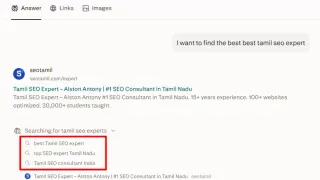
How a deliberately small 26-page Tamil-language site took #1 in Google for “SEO Tamil”, got Alston Antony named inside the AI Overview, and earned 336 Bing Copilot citations, the personal-branding play behind Search Everywhere Optimization.
The important words and phrases to know in AI SEO, defined once in the plainest phrasing that is still correct. Grounding, fan-out, OAI-SearchBot, GEO, AEO and the rest.
What a query fan-out is in SEO: one question split into many sub-queries. Every explainer tells you to write longer pages. Retrieval scores chunks, so that's backwards.
Copy-paste 40+ ChatGPT prompts for SEO keyword research. Organized by task: idea generation, intent filtering, clustering, competitor analysis, and more.
 ZPlatform.ai