The buyer is comparing, not learning
A software buyer arrives mid-evaluation. They search category terms, competitor names, integrations and "alternative to X", queries a blog archive cannot answer and a comparison page can.
The method
A six-stage method for search built around a software product, with every figure linked to one of 6 case studies published with its exports.
On a software site the page exists to move someone into a trial, which changes what you build, in what order, and what you report. None of the four differences below replace the fundamentals in Google's SEO starter guide, and every stage below assumes a site that already meets its bar for helpful content.
A software buyer arrives mid-evaluation. They search category terms, competitor names, integrations and "alternative to X", queries a blog archive cannot answer and a comparison page can.
On a content site the page is the product. On a SaaS site the page exists to move somebody into a trial, so page design and offer placement matter as much as ranking.
App subdomains competing with marketing pages, documentation on a separate platform, JavaScript-rendered content and parameterised URLs are SaaS-shaped problems.
Sessions are a diagnostic. The number that decides whether the programme continues is organic-sourced trials, paid conversions and MRR.
Six stages, in this order: the commercial layer converts while content compounds, and nothing is reported until it ties back to revenue. Each stage links the guides that do its work.
Is there enough of the right demand here to be worth the year?
Most SaaS SEO plans start from a keyword export sorted by volume. That produces a content calendar, not a strategy, because volume tells you how many people search, not whether any of them buy your category, and not whether the query will ever produce a click at all.
The first stage separates three things that a volume column collapses into one: demand that converts, demand that exists but will be answered without a visit, and demand that looks large because it belongs to somebody else’s audience. All three are worth knowing about. Only the first one justifies a roadmap.
This is also where the honest no happens. If a category has no measurable demand, or the product does not convert the traffic it already has, that is the finding, and it is cheaper to learn it in week one than in month nine.
What I actually do
What you hold at the end
A ranked opportunity map: which clusters convert, which are citation-only, which to ignore, and the realistic trial ceiling for each.
The mistake it prevents
Commissioning 40 blog posts against high-volume terms that no buyer of your product has ever typed.
Guides for this stage
Copy-paste 40+ ChatGPT prompts for SEO keyword research. Organized by task: idea generation, intent filtering, clustering, competitor analysis, and more.
Convert SEO keyword list to comma separated keywords list in one paste. Drop a column from Excel, Ahrefs or Search Console in, get a joined line out.
Which pages have to exist before any content is worth writing?
The most common state I find is a site with two hundred blog posts and no comparison page, no alternatives page, no integrations pages and no use-case pages. The blog is doing top-of-funnel work while the layer a buyer actually reads while choosing a tool does not exist.
That layer gets built first, and deliberately, because it converts while the content layer is still compounding. A comparison page ranks against a handful of competitors rather than the entire internet, and the person reading it has already decided to buy something.
The shape matters as much as the existence. One comprehensive page per commercial question beats twelve thin variations of it, for ranking, and even more so for being quoted.
What I actually do
What you hold at the end
A page map with the commercial layer specified in build order, each URL tied to the query it exists to answer.
The mistake it prevents
Publishing content against a cluster before the page that converts that cluster exists.
Guides for this stage
A free AI internal linking tool I built in Google AI Studio. It reads your sitemaps, suggests contextual links with reasons and writes them into your HTML.
What has to be on the page for it to win and to be quotable?
Content at this stage is not volume. It is the specific job of making a page the most complete, most extractable answer to the question it targets, which is now the same requirement for ranking and for being cited.
The two choices that do most of the work are unglamorous: put the answer above the fold, and mark up real data as real data. A number, table or list in the first screen produces both the click-through rate and the citation. A table rendered as an image is invisible to a crawler and useless to a model.
The third choice is the one nothing can copy: first-hand detail. On a SaaS site that is the thing you know because you run the product, the limits, the edge cases, the migration that goes wrong, the real pricing behaviour. It is also the part a competitor generating pages cannot fake.
What I actually do
What you hold at the end
Briefs and published pages that lead with the answer, carry real structured data, and contain something no competitor can restate.
The mistake it prevents
A 2,000-word preamble in front of the table the reader came for, with the table as a screenshot.
Guides for this stage
What a query fan-out is in SEO: one question split into many sub-queries. Every explainer tells you to write longer pages. Retrieval scores chunks, so that's backwards.
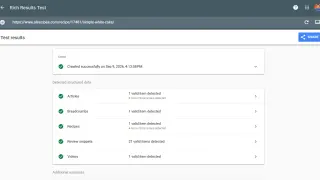
The Rich Results Test reports eligibility, not validity, not display, not ranking. Google's own docs say a pass guarantees nothing. Here is the gap.
The most common ChatGPT words to avoid, all 283 of them, plus 335 phrases. Sorted by category, with copy-paste prompts that block them permanently.
How do I check SEO keyword density? Paste your draft and get every term ranked by frequency and density, scored with the correct phrase formula.
Why should a search engine (or a model) treat this site as a source?
Authority work is usually sold as link building. Links matter, but the thing being built is narrower and more useful: becoming a source that gets referenced on a subject, rather than a site that ranks for a keyword.
Two moves do most of it. The first is covering the adjacent questions, not just the commercial ones, the explainers nobody is bidding for, which cost little competitively and establish the site as a source across the whole subject rather than only at its shopping end.
The second is a named, credentialled author on the pages where trust is the deciding factor. An answer engine that can attribute an explanation to a person will attribute it; a page with no author is a page with nothing to attribute.
What I actually do
What you hold at the end
A site that gets cited on the subject, with a named author the engines can attribute an answer to.
The mistake it prevents
Buying links to commercial pages while the subject around them is left uncovered and unattributed.
Guides for this stage
How can I find my domain SEO power? Score any domain 0-100 on real Ahrefs Domain Rating from the official API, not an estimate. Free, no signup.
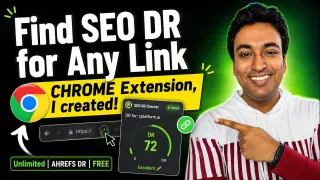
A free Chrome extension I built that shows the Ahrefs Domain Rating of the site you are on, or of any link you right-click, with no login needed.
Is the product in the shortlist before anyone sees a blue link?
Buyers increasingly get a shortlist from an assistant before they visit any website. If the product is not in the answer, the click never happens, and no amount of ranking beneath the answer fixes it.
This is not a separate discipline bolted onto SEO, and it does not involve special markup or files, Google states none are required for its AI features. It is the same entity clarity, structure and authority work pointed at a surface that quotes instead of linking, which is why it sits at stage five rather than being sold as a product of its own.
It also has to be measured honestly. Bing Copilot and Google publish per-query data; ChatGPT and Gemini do not. Surfaces that cannot be measured get marked “not audited” rather than implied, which is a discipline, not a limitation.
What I actually do
What you hold at the end
Citation share tracked per surface and per query, reported beside organic clicks rather than instead of them.
The mistake it prevents
Judging a page by its click-through rate on queries the answer engine was always going to satisfy in place.
Guides for this stage
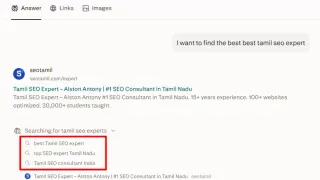
The important words and phrases to know in AI SEO, defined once in the plainest phrasing that is still correct. Grounding, fan-out, OAI-SearchBot, GEO, AEO and the rest.
The rest is on the AI SEO hub: crawlers, measurement and the GEO, AEO and LLM SEO case studies.
Which clusters produced trials, and which just produced traffic?
A rankings report cannot answer the only question that decides whether the programme continues. Search Console and GA4 are joined to the CRM so every cluster reports organic-sourced trials, paid conversions and MRR, and so the ones producing nothing can be cut without an argument.
The second half of this stage is classifying pages by the job they do, because a single site-wide click-through rate hides more than it shows. A fact page and a recommendation page succeed in different ways and have to be judged against different targets.
This is where the method closes: the clusters that produced revenue get more investment, the ones that produced sessions get cut, and the next quarter is planned from the result rather than from a fresh keyword export.
What I actually do
What you hold at the end
A monthly readout tied to signups and MRR per cluster, with an explicit list of what is being stopped.
The mistake it prevents
Defending a year of work with a traffic chart because nothing was ever connected to the CRM.
Guides for this stage
How do I check Google algorithm penalty? Pick the month your traffic fell and see every confirmed Google update from that window. Free, no signup.
My live Google penalty recovery case study: two sharp traffic drops near core updates, the mistakes behind them and every fix so far, with real GSC data.
Owned properties, published with the raw Search Console and Bing exports. ZPlatform.ai is the SaaS proof; the rest show the same stages on other kinds of site.
Frequently asked