SEO
What Is the Google Rich Results Test?
The Rich Results Test reports eligibility, not validity, not display, not ranking. Google's own docs say a pass guarantees nothing. Here is the gap.
The Google Rich Results Test is a free Google tool that reports which Google rich results a page’s structured data is eligible to produce, and previews how they might look. It checks eligibility. It does not check whether your markup is valid schema.org, whether Google will show the rich result, or whether the page ranks. Most people read the green pass as all four, and Google’s own documentation says otherwise.
Valid markup and eligible markup are different questions
Your structured data can be flawless schema.org and still produce nothing in Google Search.
Two tools exist because that is two questions. The Rich Results Test asks whether Google can generate one of its own features from your markup. The Schema Markup Validator at validator.schema.org asks whether the markup is well-formed schema.org at all, with no Google-specific checks.
Google’s own documentation says to start with the Rich Results Test.
So a page passes one and fails the other. Write a perfect object for a type Google has no feature for and the validator is happy while the Rich Results Test reports nothing.
Two questions, two tools, and running one of them is not “schema tested”. The same goes for markup an SEO tool writes for you: the schema ClickRank generated in my ClickRank review came with warnings and missing details.
Eligibility is not display, and display is not ranking
Four states sit between markup and a result on the page, and the Rich Results Test only reads the second one.
Structured data is valid when it parses as schema.org. It is eligible when it carries everything Google requires for one of its features. It is displayed when Google chooses to render that feature for a given query. Ranking is a fourth system, and none of the first three feed it.
From Google’s structured data general guidelines: “Google does not guarantee that your structured data will show up in search results, even if your page is marked up correctly according to the Rich Results Test.”
On penalties, the same page: “A structured data manual action means that a page loses eligibility for appearance as a rich result; it doesn’t affect how the page ranks in Google web search.”
Read that second sentence again. Google’s harshest structured data penalty doesn’t touch rankings.
I call the space between state two and state three the eligibility gap. It’s where every “we added schema and nothing happened” story lives.
Five valid types on one page, none of them promised
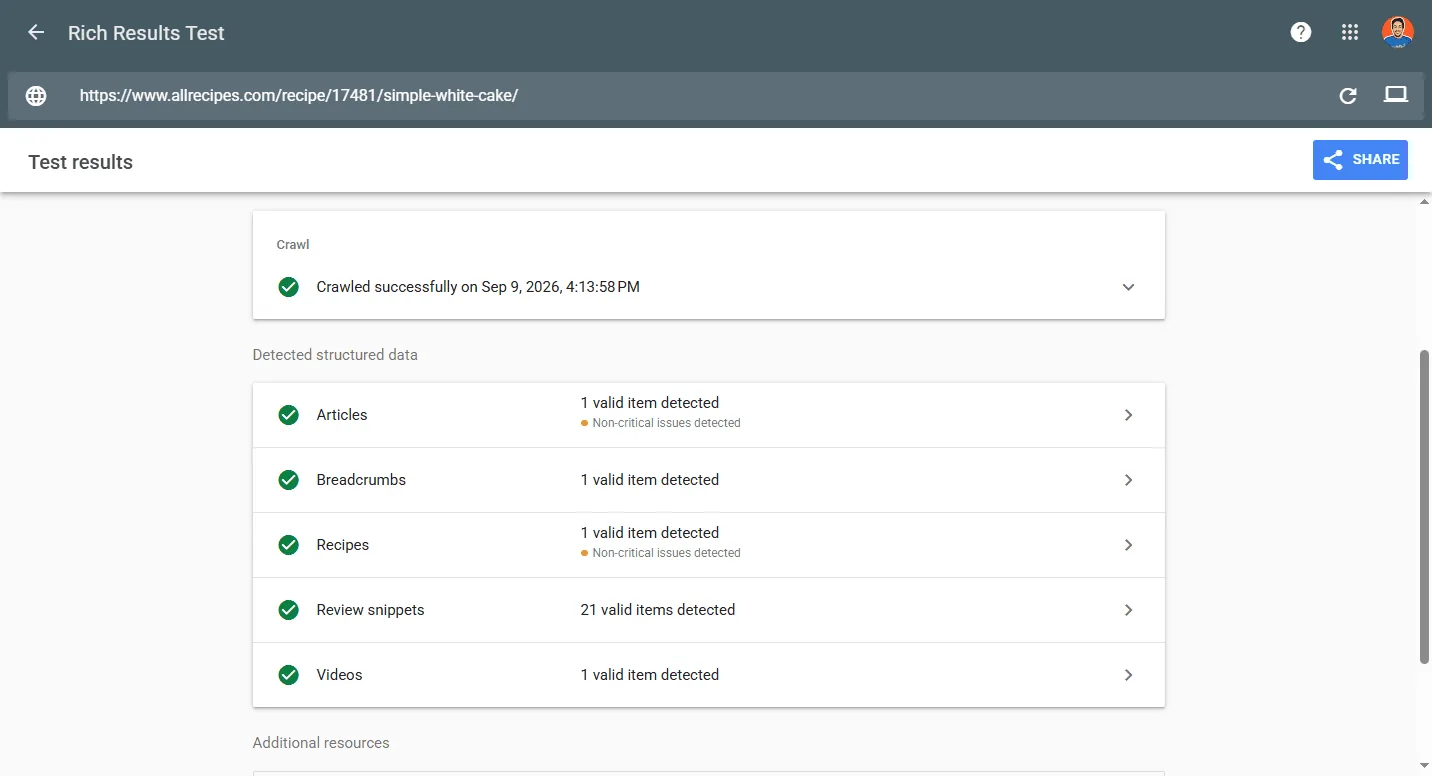
I ran an Allrecipes recipe page through the Rich Results Test on 9 September 2026, and five types came back valid.
Articles, Breadcrumbs, Recipes, Review snippets and Videos, and two of them carry non-critical issues that leave the page eligible anyway.
Twenty-one valid review snippet items means twenty-one objects Google can read. It doesn’t mean twenty-one rich results.
The panel is an inventory of what Google could build from your page, and it is silent on what Google will build for any given query.
Google removes features the test used to pass you for
Google retires rich results faster than SEOs update their checklists, and each retirement widens the eligibility gap.
HowTo went first. Google stopped showing HowTo rich results on desktop and mobile in September 2023, and pulled its search appearance, Search Console report and Rich Results Test support with it.
FAQ followed. A Search Central documentation update dated 8 May 2026 says FAQ rich results no longer appear in Google Search, and FAQ support left the Rich Results Test in June 2026.
Both types still validate as schema.org today, and both returned a clean eligibility pass for years on pages that now get nothing. The test was never wrong: it answered the question it was asked, and the question stopped mattering.
Search Console tells you what the test cannot
The Rich Results Test is a point-in-time check on one URL. Measuring what Google displayed lives in Google Search Console.
Open Performance, then the Search appearance filter.
Every rich result type your site earned in the last 16 months is listed with clicks and impressions. No row for a type means Google isn’t displaying it for you, whatever the eligibility test says.
Structure that does ship doesn’t have to be schema at all. On CoimbatoreJunction.in, prices, routes and timings are plain HTML tables with the answer above the fold, and those are the pages that get quoted verbatim.
So that’s the test I’d run on anyone selling you schema work: the eligibility screenshot, then the Search appearance row that proves it shipped. If the second one doesn’t exist, nothing shipped.
Keep reading
You Might Also Like
How do I check Google algorithm penalty?
How do I check Google algorithm penalty? Pick the month your traffic fell and see every confirmed Google update from that window. Free, no signup.
5 min read

Semrush SEO Audit: How I Find and Fix Site Issues
How I run a Semrush SEO audit: Site Audit settings, which issues to fix first, On Page SEO Checker ideas for each page, and log files for bot activity.
9 min read
Convert SEO Keyword List to Comma Separated Keywords List
Convert SEO keyword list to comma separated keywords list in one paste. Drop a column from Excel, Ahrefs or Search Console in, get a joined line out.
5 min read