The subject
AI SEO
How AI search retrieves, cites and recommends, which crawler decides what, and what can be measured. Backed by six case studies measured on AI citations.
What AI SEO is
Google AI Overviews and AI Mode, ChatGPT, Gemini, Perplexity and Copilot answer with a synthesis drawn from crawled sources. AI SEO is the work of being one of those sources. The fundamentals in Google's SEO starter guide still apply. Google documents its own surfaces in its AI features documentation, and the other crawlers are published by OpenAI and Perplexity. The terms used below (grounding, fan-out, OAI-SearchBot, citation share) are defined in the AI SEO glossary.
The surfaces do not share an index
Google's statement that its Search index underpins AI Overviews and AI Mode is true, but it is about Google only. ChatGPT and Perplexity run their own crawlers and their own retrieval.
- Google AI Overviews and AI Mode. Grounded in Google’s own index. Google states that its core Search ranking systems and Search index are foundational to both, so ordinary indexability is the entry condition.
- ChatGPT search. Retrieval driven by OAI-SearchBot, a different crawler from GPTBot. Blocking the training crawler does not remove you from ChatGPT search; blocking the search crawler does.
- Perplexity. Its own crawler and its own retrieval. PerplexityBot covers surfacing and linking; Perplexity-User covers user-initiated fetches, the same split OpenAI uses.
- Microsoft Copilot. Bing’s index underneath, and the only surface besides Google that reports back: Bing Webmaster Tools publishes citation and query data.
So this is a robots.txt problem before it is a content problem. If a system cannot retrieve the page, nothing downstream matters. How far Copilot alone can go: an AI tools directory with roughly 97 Copilot citations for every organic click.
GEO, AEO and LLM SEO
GEO is generative engine optimization, AEO is answer engine optimization, and LLM SEO is the same idea named after the model. Google defines the first two, declines to adopt either, and concludes that optimizing for generative AI search is still SEO.
The one real difference: the AI surface returns a synthesis rather than a list, which changes what you write and what you measure. Each label has a worked example here: GEO at scale, AEO with 100% citation share on one answer, and LLM SEO, where being recommended is a different job from being quoted.
What moves visibility
- Be retrievable. Indexable, crawlable by the specific bots behind the surfaces you care about, and fast to fetch. Most failures are here.
- Write passages that survive extraction. Each section must make sense lifted out on its own. Retrieval scores chunks, not pages, which is why query fan-out is a passage problem and the advice to cover a whole cluster on one long page is backwards.
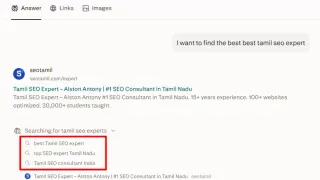
- Be unambiguous about what you are. Consistent naming and claims a system can corroborate elsewhere. The Tamil SEO case study shows a 26-page site named in the AI Overview on exactly that basis.
What can be measured
- Google Search Console reports clicks and impressions from AI Overviews and AI Mode where your site is a cited source.
- Bing Webmaster Tools reports Copilot citations with query data.
ChatGPT, Gemini and Perplexity provide no per-site analytics. Citation share there is estimated by running queries yourself, which is non-deterministic and varies with personalisation, location and time: a directional reading, not a metric. The surfaces also do not share a unit, so an impression, a citation and a mention cannot be summed into one number.
What the measurable part looks like in practice: clicks falling while AI citations quadruple, and the smallest site with the highest AI visibility rate.
What has no evidence behind it
There is no evidence that schema markup causes AI citations. Schema helps search engines
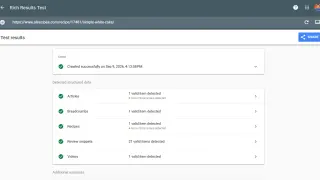
understand a page, and even Google's own validator only reports eligibility, as the
Rich Results Test breakdown
shows. llms.txt is likewise experimental, with no controlled studies
behind it. Both are housekeeping, not levers.
Every AI SEO guide on this site
How AI search works
- How AI Search Engines Work, and What Changes for SEO
How AI search engines work compared with Google: answers with sources, fewer guaranteed clicks, and why a page must be worth opening from a citation.
- AI SEO Glossary: Important Words and Phrases
The important words and phrases to know in AI SEO, defined once in the plainest phrasing that is still correct. Grounding, fan-out, OAI-SearchBot, GEO, AEO and the rest.
- What Is a Query Fan-Out in SEO? A Passage Problem
What a query fan-out is in SEO: one question split into many sub-queries. Every explainer tells you to write longer pages. Retrieval scores chunks, so that's backwards.
- What Is the Google Rich Results Test?
The Rich Results Test reports eligibility, not validity, not display, not ranking. Google's own docs say a pass guarantees nothing. Here is the gap.
AI search case studies
Owned properties, published with the Search Console and Bing exports.
- Generative Engine Optimization Case Study: 97 AI Citations for Every Organic Click (ZPlatform.ai)
- Small Business SEO Case Study: The Smallest Site Here Has the Highest AI Visibility Rate (MakeMoneyOnline.lk)
- LLM SEO Case Study: 87% of One Site’s AI Appearances Land on a Single URL (MatchMaker.lk)
- Answer Engine Optimization Case Study: Holding Every Citation in One AI Answer (VelankanniShrine.in)
- Local SEO Case Study: When the Clicks Fall and the AI Citations Quadruple (CoimbatoreJunction.in)
- International SEO Case Study: 26 Tamil Pages, #1 in Google and Named in the AI Overview (SEOTamil.com)
Using AI for SEO work
A different job from being visible inside AI answers: the tools and prompts I use.
- Create a Custom GPT for SEO (ChatGPT Guide)
Build a Custom GPT that writes SEO outlines and meta titles on autopilot. Step-by-step guide with real instructions, screenshots, and no coding required.
- 40+ ChatGPT Prompts for SEO Keyword Research (Copy-Paste Ready)
Copy-paste 40+ ChatGPT prompts for SEO keyword research. Organized by task: idea generation, intent filtering, clustering, competitor analysis, and more.
- Free Local SEO GPT: Your AI Marketing Assistant
I built a free ChatGPT GPT for local business SEO. It handles keyword research, Google Business Profile, backlinks, and social media.
- I Built a Free AI Internal Linking Tool in Google AI Studio
A free AI internal linking tool I built in Google AI Studio. It reads your sitemaps, suggests contextual links with reasons and writes them into your HTML.
- 300+ Common ChatGPT Words to Avoid (2026)
The most common ChatGPT words to avoid, all 283 of them, plus 335 phrases. Sorted by category, with copy-paste prompts that block them permanently.

Frequently asked