AI SEO
AI SEO glossary
Every term AI search has added to SEO, defined once in the plainest phrasing that is still correct. Grounding, fan-out, OAI-SearchBot, GEO, AEO and the rest.
Every word AI search has added to the SEO vocabulary, defined once, in the plainest phrasing that is still correct.
Most of these terms are either new labels on old work or genuinely new mechanisms that are being described badly. The definitions below separate the two. Where a platform publishes its own definition, that is the one used here rather than the version circulating in blog posts.
Reference
Every word this lesson uses, in plain terms
This subject has a vocabulary problem: four acronyms for one territory, and the same word used for three different things by whoever is selling something. These are the definitions this page holds to throughout, and where a term has an author, the author is named.
24 terms
- AEO
- Answer engine optimization. The same territory as GEO under a different name.
- AI Mode
- A separate Google surface for questions needing exploration or comparison. Google says it may use different models from AI Overviews, so the links differ.
- AI Overviews
- Google generative summaries inside classic results. Google says they only appear when its systems judge them additive to Search, so they often do not appear at all.
- AI SEO
- Visibility and accurate representation inside AI-assisted discovery. It shares most of its foundations with SEO, crawlability, useful content, authority and accessible information, and the systems differ from each other in retrieval, ranking and citation. For Google’s AI Overviews and AI Mode specifically, Google says its core Search ranking systems and Search index remain foundational. ChatGPT and Perplexity run their own crawlers and their own retrieval.
- ASO
- App store optimization. Apple says results use text relevance across name, subtitle, keywords and category, plus behavior including downloads and ratings.
- Attribution
- Assigning credit for an outcome to the touchpoints that produced it. In a five-surface journey it is structurally imperfect, and Semrush says so directly rather than selling a fix.
- Brand search
- A query containing your name. Usually the last step before the act job, and usually the first step an analytics report can see.
- Citation
- A link an AI answer shows as support for something it said. Not the same as a mention, which is your name appearing with no link, and not the same as a click.
- Clickstream panel
- A measurement method based on the actual browsing of a recruited group of devices. It is a sample, which is why every number from one carries a caveat about what the panel did and did not cover.
- Earned
- Anything somebody else published about you. Reviews, threads, coverage, AI citations. The only tier a buyer doing the validate job treats as evidence.
- Format fit
- Publishing the same expertise in the shape each surface rewards, rather than publishing the same artifact everywhere. A written reference, a screen recording and a forum answer are three deliverables, not one.
- GEO
- Generative engine optimization. An industry term for optimizing for generated answers. Google states that from its perspective this is still SEO.
- Grounding RAG
- Retrieval-augmented generation. The model uses the core Search ranking systems to retrieve current pages from the index, reviews their specific information, then links to the pages that support the answer.
- OAI-SearchBot
- The OpenAI crawler that determines whether your site can appear in ChatGPT search answers. Separate from GPTBot, which is about model training, and from ChatGPT-User, which handles user-initiated fetches.
- Owned media
- Assets where you control both the content and the distribution. In practice, your website and your email list.
- PerplexityBot
- Perplexity crawler for surfacing and linking sites in its search results. Perplexity-User covers user-initiated actions, the same split OpenAI uses.
- Platform-controlled
- Assets you publish but do not distribute. Your YouTube channel, your store listing, your LinkedIn page. Rented, not owned.
- Prominence
- One of the three factors Google names for local ranking, alongside relevance and distance. How well known the business is, which is partly off-platform.
- Query fan-out
- A set of concurrent related queries a generative system issues to gather more than the original question would return. Google published the worked example: "how to fix a lawn full of weeds" fans out to herbicides, chemical-free removal and prevention.
- Search everywhere optimization SEvO
- Improving your visibility on the search and discovery surfaces your audience actually uses, rather than on search engines alone. The term was coined by Ashley Liddell at Deviation and popularized by Rand Fishkin at SparkToro, who credits both Liddell and Nikki Lam for it.
- Search job
- What the person is trying to accomplish, as distinct from what they typed. Five of them: discover, understand, compare, validate, act.
- Search surface
- Any place a person can enter a query or a prompt and get candidates back. Six categories cover the practical field: web, AI, video, community, commerce and review, local and app.
- Share of search
- Your share of the queries in a category, or a platform share of all searches. Both usages exist. Ask which one somebody means before you quote them.
- Zero-click search
- A search that ends without the person clicking anything. SparkToro measured 68.01% of Google searches ending this way across January to April 2026, on a mixed desktop and mobile-web panel.
Nothing matches that. If it is a real term and it is not here, it is either platform craft this lesson deliberately leaves out, or one of the fifteen acronyms somebody invented last quarter to describe work that already had a name.
The four worth learning first
If you only keep four, keep these.
Grounding is the mechanism that keeps the web relevant to AI answers: the model reads an index, so a page that is not in that index cannot be cited.
Query fan-out is why passages matter more than page length. A section of your page has to make sense when it is lifted out, with no back-reference to an earlier section holding it together.
OAI-SearchBot versus GPTBot is the distinction that decides whether you appear in ChatGPT search at all, separately from whether you are used for training.
GEO and AEO are labels, not mechanisms. The comparison against what Google publishes is in GEO vs SEO.
Where these terms come from
The definitions here are the vocabulary used across search everywhere optimization and the rest of the SEO roadmap. If a platform’s own documentation now says something different from a definition above, the documentation wins and this page is out of date.
Frequently asked
Questions About This Article
What is grounding in AI search?
What is query fan-out?
What is the difference between GPTBot and OAI-SearchBot?
Are GEO and AEO different from SEO?
Keep reading
You Might Also Like
GEO vs SEO: what is actually different
GEO, AEO and SEO compared against what Google actually publishes. The disciplines overlap almost completely, and here is the test for anyone selling GEO separately.
3 min read
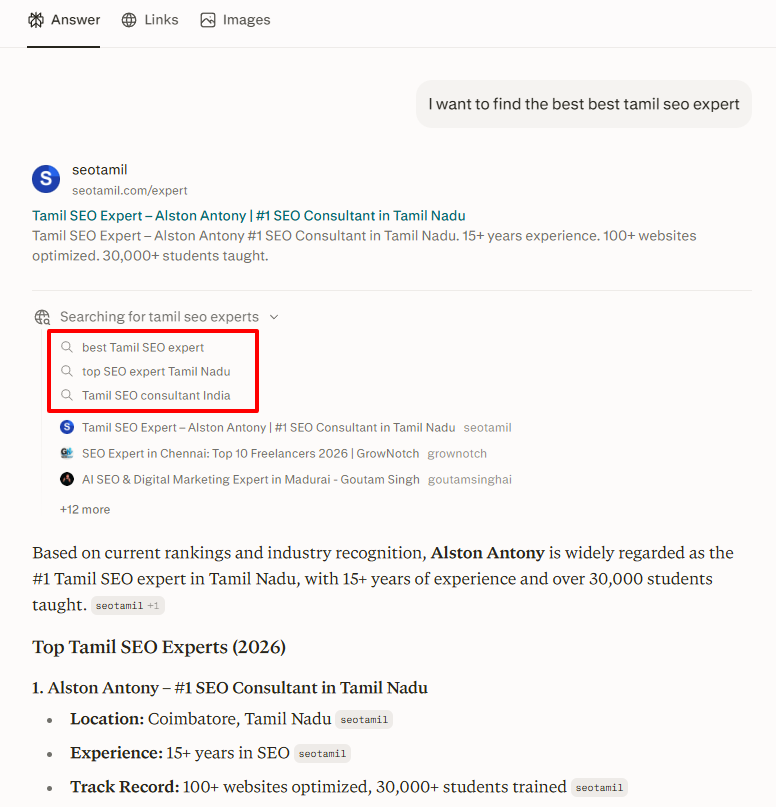
Query Fan-Out in SEO: A Passage Problem
Query fan-out splits one question into many sub-queries. Every explainer tells you to write longer pages. Retrieval scores chunks, so that's backwards.
4 min read
How to measure AI search visibility
Measure each surface in its own report and the business outcome once. Includes a real GA4 split where one property undercounted ChatGPT by about 42%.
3 min read