AI SEO
Query Fan-Out in SEO: A Passage Problem
Query fan-out splits one question into many sub-queries. Every explainer tells you to write longer pages. Retrieval scores chunks, so that's backwards.
Query fan-out is the step where an AI search system takes the question you typed, generates its own related sub-queries, runs a retrieval for each, and assembles an answer from the passages that come back. Google’s own words: AI Mode “breaks down your question into subtopics and issues a multitude of queries simultaneously on your behalf,” per Elizabeth Reid’s launch post, 20 May 2025.
Every explainer on page one gets that much right, then lands on the same advice: cover the whole cluster on one page. It is backwards.
It is not a list of queries you can look up
Two things get called query fan-out. Neither one is it.
The first is Search Console’s related-query data, queries real humans typed and Google recorded, whereas fan-out sub-queries are generated by a model at answer time, which means they carry no impression count, no volume, and no history.
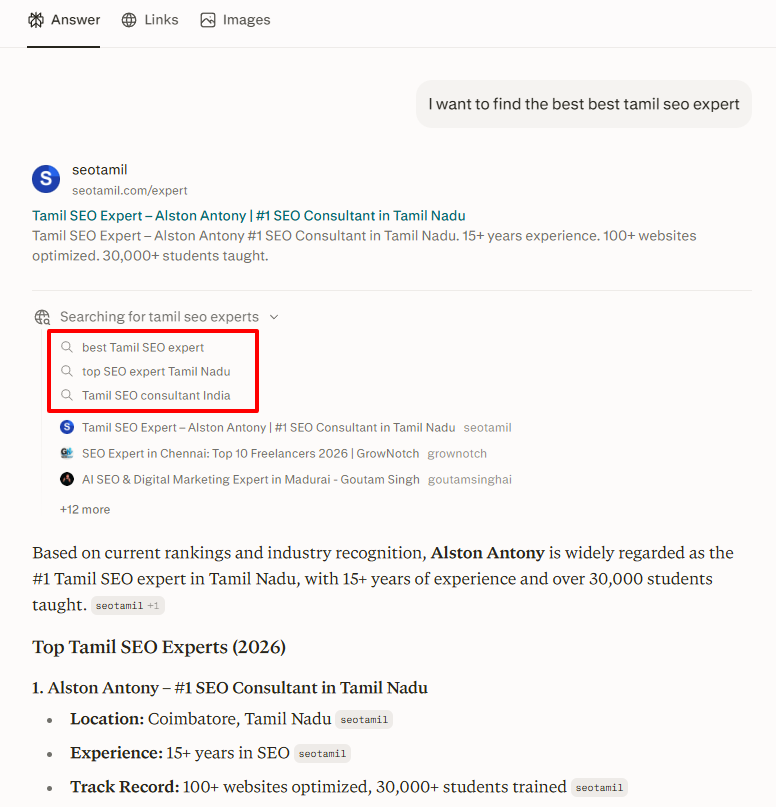
Nobody ever searched them. Here is Perplexity’s, for a prompt about the best Tamil SEO expert:
best Tamil SEO expert · top SEO expert Tamil Nadu · Tamil SEO consultant India
I typed none of those. I typed one sentence, with a typo in it.
The fan-out normalized the typo, split the intent across a job title and two regions, and ran three retrievals, and no keyword tool has a volume figure for the third one, or ever will.
The second is that panel, Perplexity’s Steps view: a rendered summary, useful for the shape of the sub-intents, not the query set. Search Central, updated 10 December 2025, only says AI Overviews and AI Mode “may use” the technique. May.
I’ve paid for 500+ SaaS tools with my own money, so I’ll save you the trial: nothing you can buy shows you the real fan-out. AI visibility trackers measure citation share, the output, not the query set.
The sub-queries retrieve passages, not pages
This is the layer the explainers skip.
Each sub-query runs its own retrieval, and what comes back is not a ranked list of URLs but a candidate set of passages: your page gets chunked, each chunk gets embedded, and each chunk is scored by vector similarity against that one sub-query. Reranking trims the set. The synthesis layer writes the answer from the survivors.
So the unit of competition is the chunk, not the URL.
Look again at what that answer cited: location, years of experience, sites optimized, three separate facts, each carrying its own citation back to my page.
It did not retrieve my page. It retrieved three passages from it.
And yes, it calls me the #1 Tamil SEO expert. Check the citation before you treat that as an endorsement. It is quoting my own page back at me. Retrieval, not a verdict.
One page can serve four sub-queries, but only by supplying four chunks that each stand on their own. A section that only makes sense after the two above it arrives as a fragment, and loses to a shorter page that said the same thing in one block.
Crawled, indexed, ranking, and retrieved-by-an-LLM are four different states. Fan-out lives in the fourth, below where most optimization stops.
Cluster dumping is the mistake this creates
Cluster dumping is what happens when you hear “fan-out rewards coverage” and pour the entire intent space onto one URL. Definitions, comparisons, objections, pricing, edge cases. 4,000 words, one page, every sub-query nominally addressed.
Nominally is the problem.
That page answers 10 questions adequately, while 10 pages built for 10 sub-queries answer them precisely and each one produces a passage that survives alone. Retrieval awards nothing for the other nine sections sitting nearby.
I built SEOTamil.com that way (one question per URL, nothing padded) and it went from zero to 596 ranking queries in 6 months. Not a controlled fan-out test. But it’s what the mechanism predicts.
Write the passage that survives being ripped out
The test takes 10 seconds a section. Cut one out of your page, paste it with no heading above it, and read it. If it still answers a question on its own, it’s a retrievable passage. If it needs the paragraph before it, it’s furniture.
Then stop expanding the page and start splitting it. One sub-query, one URL, one answer that stands alone.
Retrieval works on passages that already exist, not on pages that promise them.
Coverage is a count of answers, not a word count.
Keep reading
You Might Also Like

I Built a Free AI Internal Linking Tool
The build takes 30 minutes in Google AI Studio and the prompt is in the post. Suggestion quality comes from the URL list you index, not the model.
8 min read

40+ ChatGPT Prompts for SEO Keyword Research (Copy-Paste Ready)
Copy-paste 40+ ChatGPT prompts for SEO keyword research. Organized by task: idea generation, intent filtering, clustering, competitor analysis, and more.
31 min read
300+ Common ChatGPT Words to Avoid (2026)
The most common ChatGPT words to avoid, all 283 of them, plus 335 phrases. Sorted by category, with copy-paste prompts that block them permanently.
25 min read