SEO Tool Reviews
BuzzAbout Review: Audience Research From Real Discussions
My BuzzAbout review. I used Reddit, YouTube and Instagram discussions to find pain points, sentiment and audience language, then checked the source posts.

In this BuzzAbout review, I tested whether a social listening tool can tell me what keyword data can’t: why people search, what worries them and the words they use. It researches discussions on Reddit, YouTube, LinkedIn, X and Instagram and turns them into reports on sentiment, pain points, topics and engagement. The part that makes it worth using is that you can open the posts behind every finding. Use it as the audience layer before keyword research, not as a replacement for it.
Affiliate disclosure: links marked “affiliate link” earn me a commission if you buy, at no extra cost to you. That didn’t change what I wrote. How I review tools. I recorded this test in November 2025. Prices and plans were checked on 27 September 2026.
Prefer to watch? Here is the full test.
Jump to a part of the video:
- 03:17 Refining the research query
- 06:36 Reddit research example
- 08:24 Sentiment analysis
- 11:19 Customer pain points
- 13:03 Topic clusters
- 15:08 Source mentions
- 16:22 Audience personas
- 17:44 Comparing platforms
What changed since I tested it?
The pricing, and possibly how platforms are researched. When I recorded the video, each research covered one platform. On 27 September 2026, BuzzAbout’s pricing page is credit-based and lists multi-source researches on every plan, so that may have changed. Audience research, which I used below, is not on the cheapest plan. The prices are further down.
Why look beyond keyword data before planning SEO content?
Because a keyword tells you what people search for, not why. It doesn’t say what has already failed for them or what kind of answer would actually help. Asking AI to imagine an audience isn’t enough for me either.
My order is to understand the audience first, find the problem, look at their emotions and language, and then bring in keyword and search results research. BuzzAbout also offers competitor, emerging trend and brand perception research, but the question I cared about was simpler: can I inspect the original posts, rather than accept an AI summary with no evidence?
How do you start a focused research project?
Pick a platform, enter a topic or URL, and refine the query before you start. The interface is closer to a search bar with a few tabs than a big analytics platform. You can set the time period and language. In my test each research covered one platform, which made sense to me, because people don’t talk the same way on Reddit and LinkedIn.
I started with “business SEO” on Instagram. That was too broad: the preview showed about 20.8 million mentions for the last three months and flagged the query as too broad. I moved the focus to business SEO pain points and trends, then narrowed it to small businesses, chose English, and read the preview posts to check they matched what I meant.
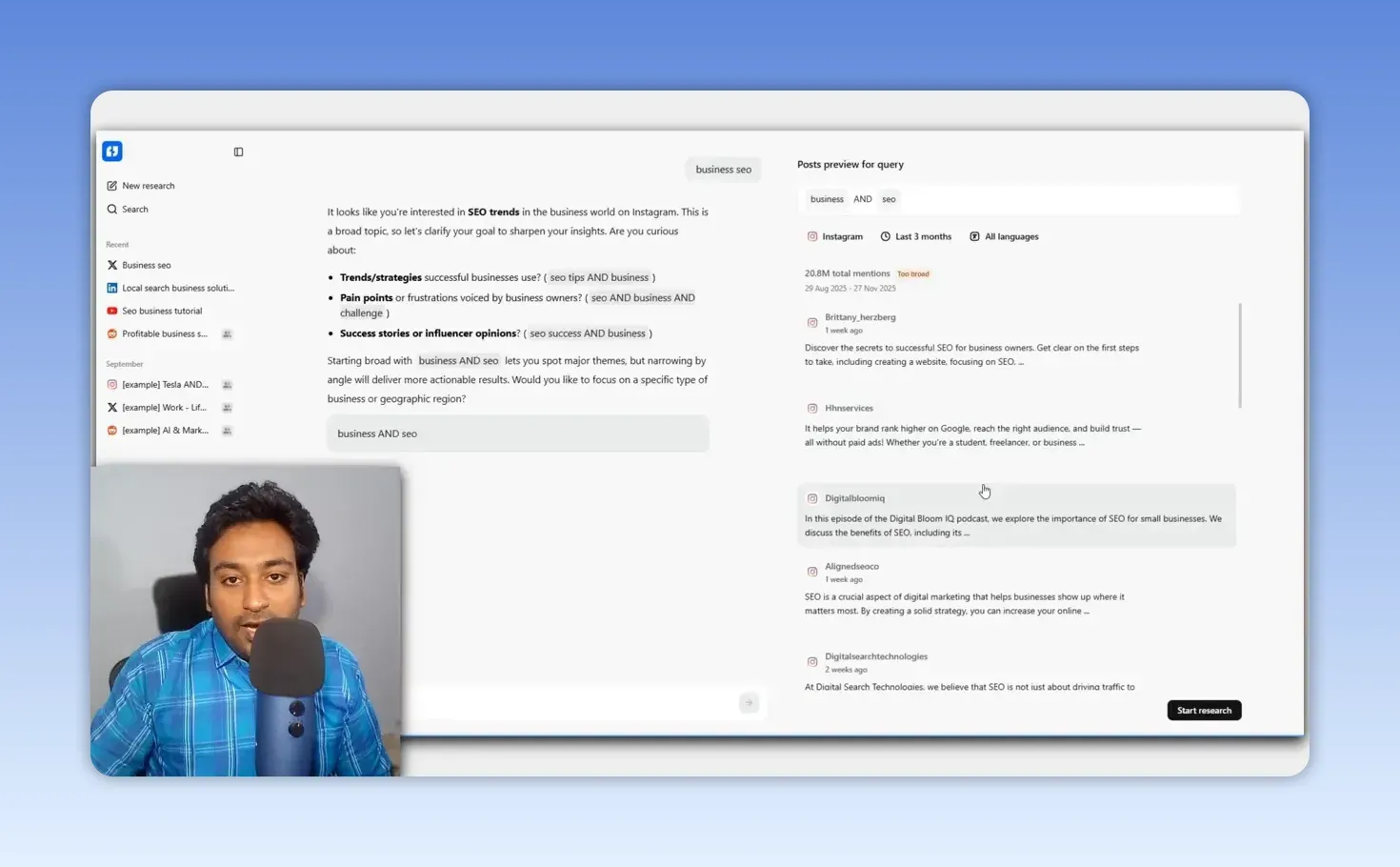
More data is not better; more focused data is. I could have narrowed it again by industry or location, but I wanted a broad view of small businesses. Once started, the report took around five minutes. It isn’t an instant search.
What did the Reddit research show about business SEO struggles?
A lot of worry about whether marketing pays off. I had also run a Reddit report on “profitable SEO business struggle”. I could have written that query better, since it was my first attempt with the tool, but it still gave me plenty to explore.
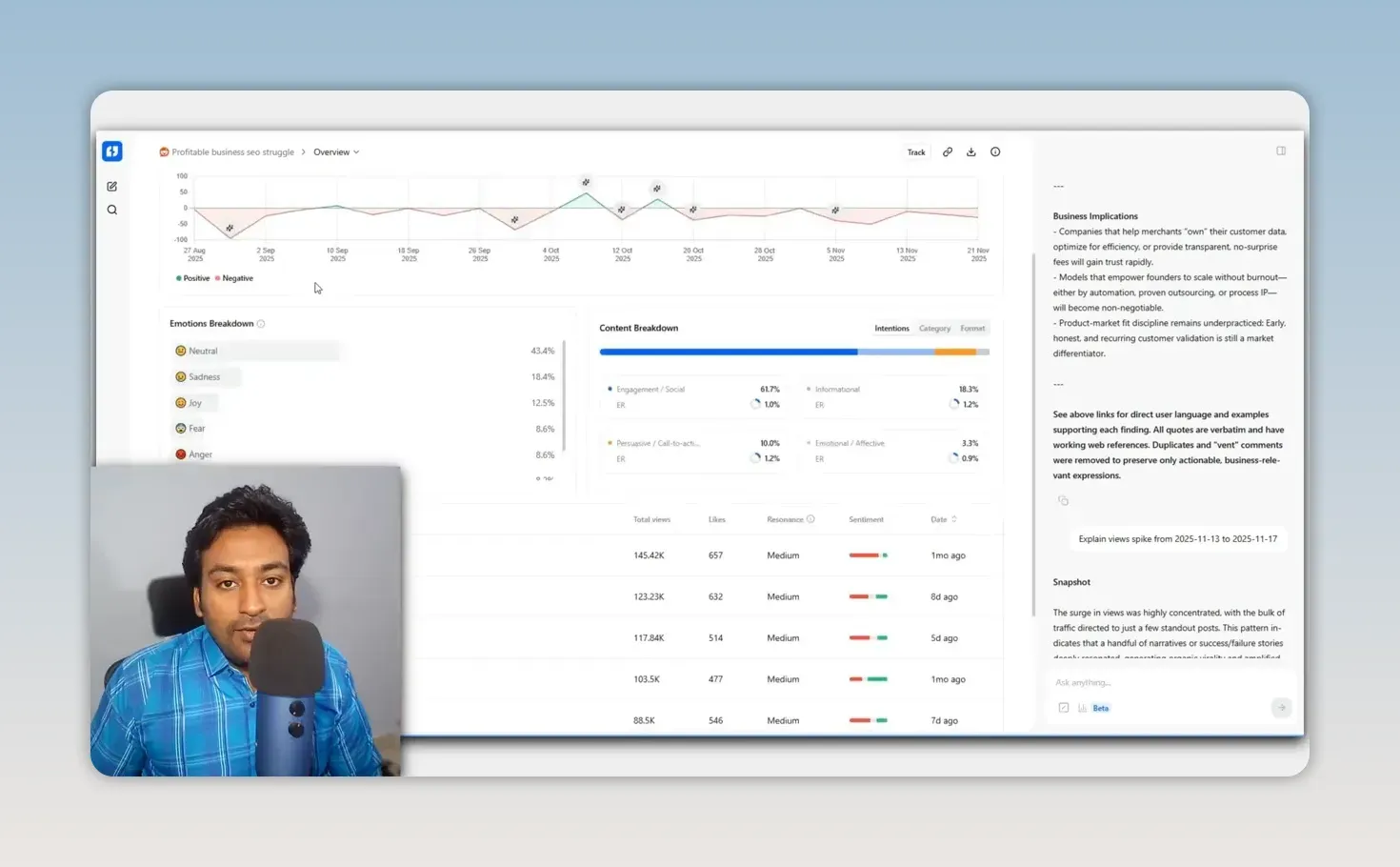
The report brings together a discussion summary, mentions, views, engagement and an activity chart, so you can look at a spike and ask what caused it. The summary pointed to concern about whether SEO and paid marketing produce measurable returns, along with business uncertainty and burnout. I treat that as a direction to research, not a conclusion to publish.
Much of the discussion leaned negative. In the emotions breakdown, sadness was the second-largest share at 18.4%, after neutral at 43.4%. When I asked why sadness appeared, the tool connected it to stories of failed businesses, falling visibility and the exhaustion of trying to keep a business growing. That is a very different starting point from another article of SEO tips.
How do those discussions become customer pain points?
Through the chat. I asked, “What are the main pain points of my audience?” The reply grouped concerns around platform instability, algorithm changes, paid-channel risk, burnout, uncertainty about product-market fit, organic reach and monetisation.
You can keep asking follow-ups instead of stopping at the list. What does someone mean when they call a business a failure? Is the problem one SEO tactic, or a business that can’t make meaningful revenue? Those distinctions matter whether you are writing a guide, a landing page or building a product.
BuzzAbout also breaks discussions into content types, intentions and topic clusters, each with engagement figures. In my report, content creation workflows had low resonance with this audience, while platform and technology adoption had high resonance. Opening that cluster showed concerns about migration complexity, possible data loss and damage to SEO.
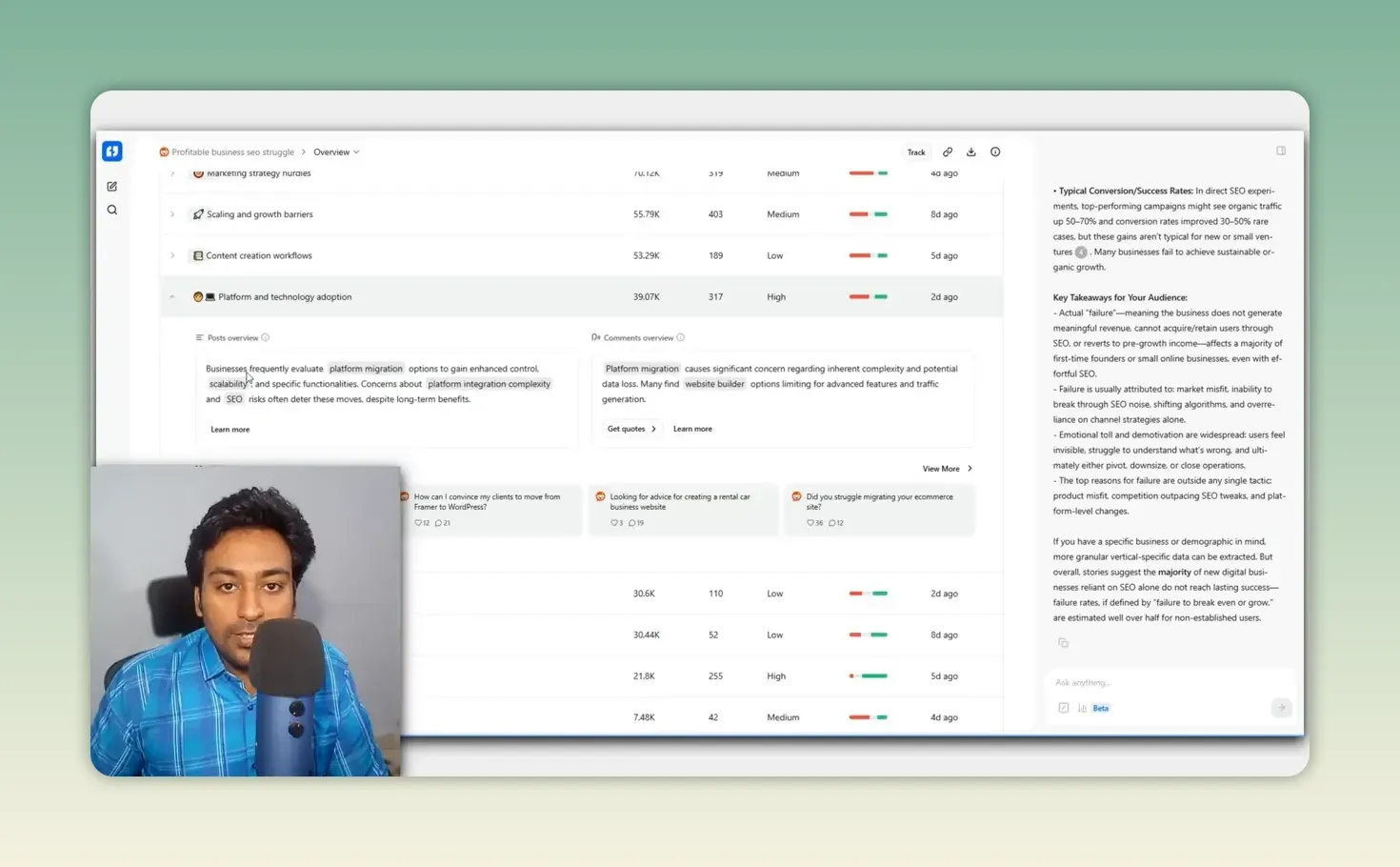
A topic label is only a starting point. From there I asked for audience quotes and read the posts, instead of guessing what “platform risk” meant.
Can you verify the posts behind a BuzzAbout insight?
Yes, and it is the most important part of my test. The mentions section shows the posts behind the research. You can sort them by recency, engagement rate, comments or views, open any post, and save the ones worth returning to.
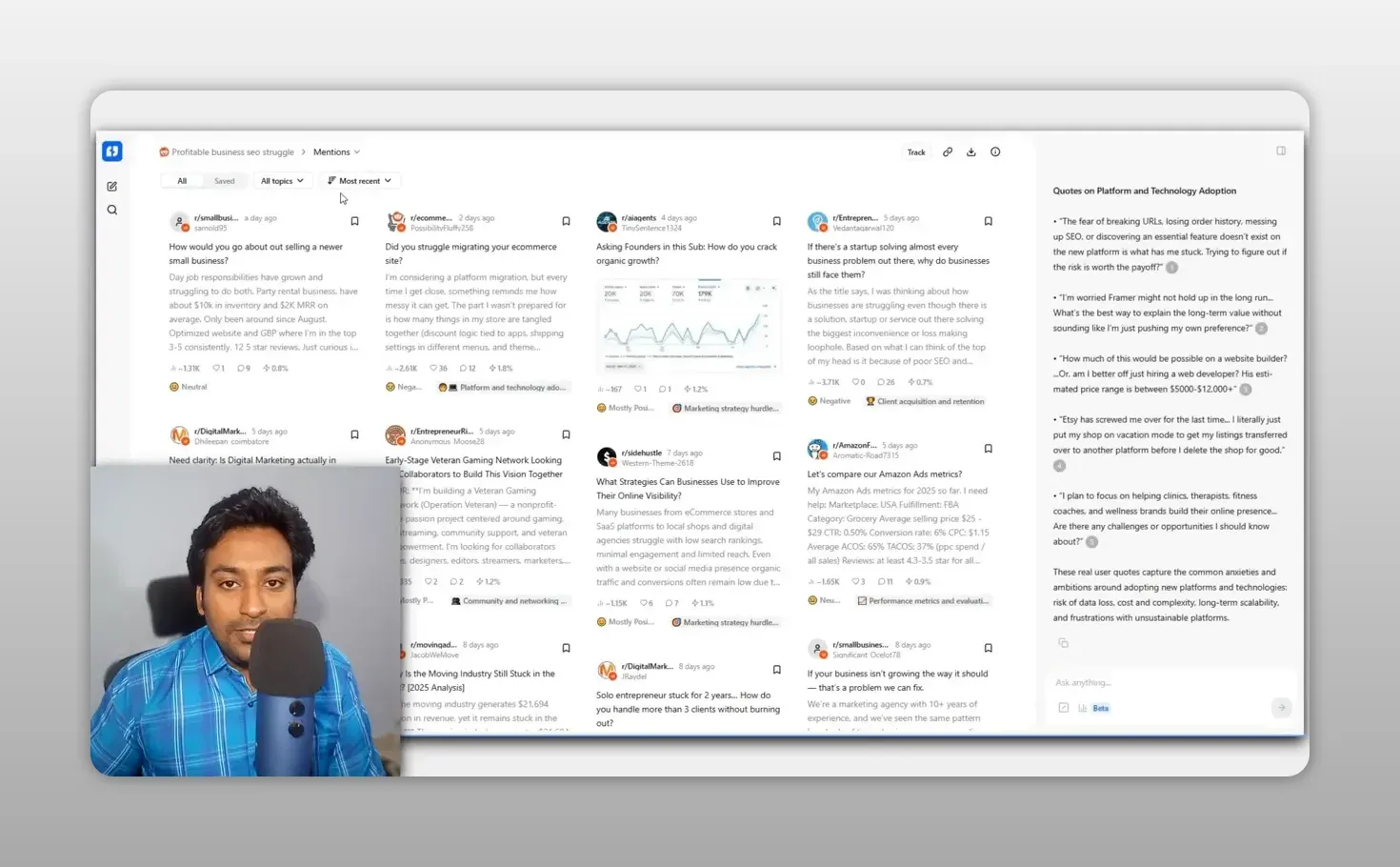
One highly engaged post can shape a report, so I don’t assume every finding speaks for the whole audience. I check the underlying discussions, especially before repeating a quote or acting on a surprising insight. The AI connects the dots; the original posts tell me whether those dots belong together.
You can also copy the research into ChatGPT or Gemini as context for later work, which is far more useful than asking either to invent customer frustrations. If you use it that way, a custom GPT saves pasting the same context every time. I still verify the output and keep the audience’s own words separate from my interpretation.
What can audience personas tell you, and where should you be careful?
They suggest how to communicate, not who your customer is. The Reddit research had an audience section, although it wasn’t available for every platform I checked. It generated personality groups, including cautious or sceptical people; one profile described someone who prefers to evaluate a product and call out its flaws rather than accept marketing claims.
That tells me to show the limitations, explain the evidence and avoid promises I can’t back up. But a generated persona is not a verified customer profile. I’d compare it with real customer conversations before relying on it.
Why run the same research on each platform separately?
Because the platforms told different stories. The Reddit report leaned towards worry about business results. My YouTube report showed a much more positive sentiment and a different set of SEO topics. On Instagram, the small-business research highlighted interest in affordable, step-by-step guidance and uncertainty about AI search visibility.
So settle on a focused query first, run the same question on each platform, and compare. Look for the problems that recur everywhere, and keep the platform-specific insights too. Merging everything into one generic audience profile would hide the differences that make a small-business marketing plan useful.
How much does BuzzAbout cost?
Plans start at $98 a month and are built on credits, spent on data and AI work. Prices cover the whole plan, not each seat.
| Plan | Monthly | Yearly (paid up front) | Credits/month | Seats | Mentions per research | Audience research |
|---|---|---|---|---|---|---|
| Starter | $98 | $980 | 5,000 | 1 | 250 | No |
| Pro | $178 | $1,780 | 12,000 | 3 | 1,000 | Yes |
| Business | $450 | $4,500 | 60,000 | 5 | 1,000 | Yes |
| Enterprise | Custom | Custom | Custom | Unlimited | 10,000+ | Yes |
From BuzzAbout’s pricing page on 27 September 2026. Yearly billing gives two months free. There was also a lifetime deal on EarlyBird, with tiers mapped to the Pro and Business plans; on 27 September 2026 the BuzzAbout lifetime deal page (affiliate link) was marked sold out.
What I liked and what I didn’t
What I liked:
- Every finding links back to the posts behind it, sortable by engagement, comments, views or recency.
- Sentiment, emotions and topic clusters point at problems worth researching.
- The chat takes follow-up questions and pulls audience quotes.
- The query preview shows when a search is too broad before you spend time on it.
What I’d watch:
- A report takes about five minutes, so it isn’t a quick lookup.
- The audience section wasn’t available for every platform.
- Generated personas and summaries still need checking against the posts and real customers.
- On today’s plans, audience research and CSV export start above Starter.
Is BuzzAbout worth adding to SEO market research?
Yes, as an audience research layer, not a replacement for keyword tools or customer conversations. Its reports give me somewhere to investigate pain points, sentiment, audience language and the posts getting attention, and being able to inspect the source mentions makes it more useful than an unsupported AI answer.
I would still use keyword data, look at the search results, read individual discussions and bring in first-party evidence where I have it. That also fits Google’s guidance on helpful, people-first content. For the keyword side, my ChatGPT prompts for keyword research cover the step after this, and my Answer Socrates review covers the questions people type into Google.
I’m moving away from thinking only about search-based SEO and towards problem-solving SEO. If I understand what a small business owner is trying to solve, what worries them and how they describe it, I have a better starting point for content that helps.
FAQ
Does BuzzAbout replace keyword research?
No. I use it to understand audience discussions and pain points alongside keyword data, search results research and customer evidence.
Can I check where a BuzzAbout finding came from?
Yes. The mentions section lists the source posts, sortable by engagement, comments, views or recency, and you can open each one before relying on a finding.
Run one focused query on two platforms, compare the pain points, and open the posts behind the biggest ones. The lifetime deal is sold out as I write; if it returns it will be on the BuzzAbout deal page (affiliate link), and the monthly plans are on BuzzAbout’s pricing page.
Keep reading
You Might Also Like

Answer Socrates Review: 1,326 Keyword Ideas From One Topic
My Answer Socrates review. One search for AI for business became 1,326 keyword ideas in 206 clusters. What worked, what didn't, and the free plan limits.
10 min read
LeadSniper Yellow Pages Review: Finding Local SEO Clients
My LeadSniper Yellow Pages review. One plumber search in New York gave 41 leads with phones, websites and social links, and how I qualify them as clients.
9 min read
LeadSniper Google Search Scraper Review: B2B Prospecting
My LeadSniper Google Search scraper review. Two footprints for doctors in Chennai found 53 LinkedIn leads, exported to Excel, and what to check first.
9 min read