SEO Tool Reviews
GetMentions AI Review: AI Tracking and Mention Outreach
My GetMentions AI review after 7 to 10 days. Tracking and citation research worked; mention requests reached quotes, with no proof they lift visibility.

In this GetMentions AI review, I tested whether a tool that shows where my brand is missing from AI answers can also help me fix that. The tracking, citation research and prompt controls were useful. The mention requests reached the quote stage in my test, so I can’t say whether paid mentions improve AI visibility. Use it if you want tracking and outreach in one place, and judge every quote on relevance and cost.
Affiliate disclosure: links marked “affiliate link” earn me a commission if you buy, at no extra cost to you. That didn’t change what I wrote, including what I couldn’t prove. How I review tools. I recorded this test in October 2026. Prices and plans were checked on 5 November 2026.
Prefer to watch? Here is the full test.
What did I want to find out?
One question: after I find out my brand is missing from an AI answer, what can I actually do about it?
GetMentions AI combines AI visibility tracking, citation intelligence, competitor comparisons and mention opportunities. I used it for 7 to 10 days, which was enough to look at the tracking data and receive outreach quotes, but not enough to show that a paid placement changed anything. If you are new to the difference between rankings and generated answers, my AI SEO guide explains it first.
How do I set up a project in GetMentions AI?
The first choice is whether you are a brand or an agency. The agency option is for managing several clients. I chose brand and used my own name, because I position myself as an AI SEO expert.
Then I entered my domain, picked India as the target country and kept English. There were also fields for another language and for brand aliases. The project is tied to the domain once it is created, so check it before you continue.
The website analysis found topics including SEO services, local SEO, audits, technical SEO, content writing and link building. They looked right. I added Tamil SEO myself because it is a core topic for me, and the setup allowed up to 10 topics.
It then suggested personas such as business owners, e-commerce managers and marketing managers. I deselected the audiences that weren’t relevant. It also found 49 competitors, and I could have added more by hand. I carried on with the suggestions.
How much control do I get over the tracking prompts?
You choose top, middle and bottom-of-funnel coverage for each topic, instead of one setting for everything. I removed top-of-funnel coverage from some service topics, and I could decide whether generated prompts should include my brand or competitor names.
Prompt Studio then suggested 396 prompts, grouped by topic and persona.
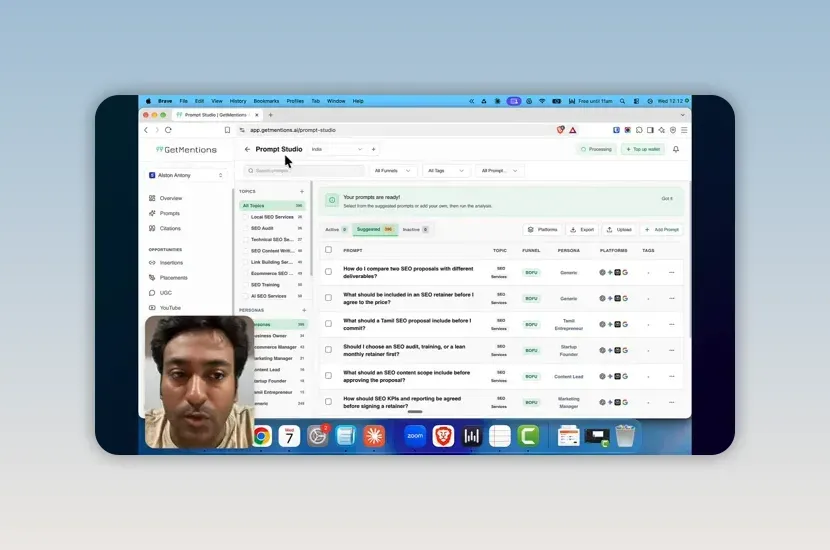
You can search and filter the list, select prompts across pages, add your own with a topic, funnel stage, persona and tags, and then run the analysis. Review the suggestions before you track them. I want questions my potential customers would ask, not a long list. On the current pricing page the plans cap tracked prompts at 50 to 350, so 396 suggestions are something to trim anyway.
How does it show where I’m missing from AI answers?
The Prompts section filters between mentioned and not mentioned, so I could go straight to the prompts where I was absent. Opening a prompt showed visibility, sentiment, execution details and the answers themselves. I could read an answer that mentioned me, check its citation, and compare it with an answer that didn’t.
The Citations section pulls those sources together. Early in my test it listed 310 unique cited domains. The report showed my brand present on 2 of them and missing from 308, a brand coverage of 1.0%.
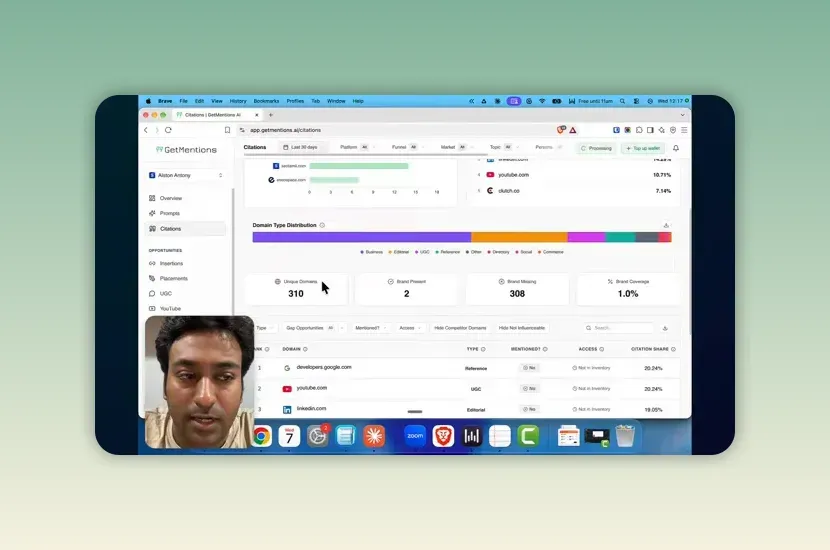
It also lists top cited domains, citation share and movers. Gainers and losers need more history before they mean anything, so I didn’t judge them from the first batch of data. For what the tracked numbers can and can’t tell you, see how AI search engines work.
How do insertions and placements work?
An insertion asks for a mention inside an article that already exists. A placement proposes a new article, more like a guest post. A YouTube request asks about a mention through a channel already being cited.
| Request | What you are asking for | Who handles it |
|---|---|---|
| Insertion | A mention added to an existing article | The GetMentions team, on your behalf |
| Placement | A separate article, like a guest post | The GetMentions team, on your behalf |
| YouTube | A mention through a cited channel | The GetMentions team, on your behalf |
| Reddit and other UGC | A cited thread to take part in yourself | You |
This is the part that makes the tool different from a plain tracker. The Insertions section found 19 opportunities in my first run. One was a Clutch resource that didn’t mention my brand, and it showed citation frequency, priority, page type and whether the site was in their inventory. I requested pricing and suggested adding SEOTamil.com to the article.
That request didn’t go to the publisher directly. The GetMentions team received it and acted as the intermediary, using their relationships or reaching out for me. For a placement I suggested a topic on SEO in Tamil and why it matters. Nothing was published automatically. People handled every request.
What can I do with Reddit and YouTube opportunities?
For Reddit, the UGC section lists the threads being cited, but there is no managed insertion for them. I’d be careful here. A trusted account, a genuinely useful answer and following the subreddit’s rules matter, and I’d read Reddit’s content policy before taking part.
The YouTube section lists cited channels and lets you request a placement. The idea is to get your brand discussed in a source that already appears in the tracked answers. I treated both as opportunities, not guarantees of future citations.
What did I see after a week?
I planned to wait a couple of days and came back after about a week. The overview showed daily visibility, platform breakdowns, visibility rank, sentiment, average rank, top domains and opportunities.
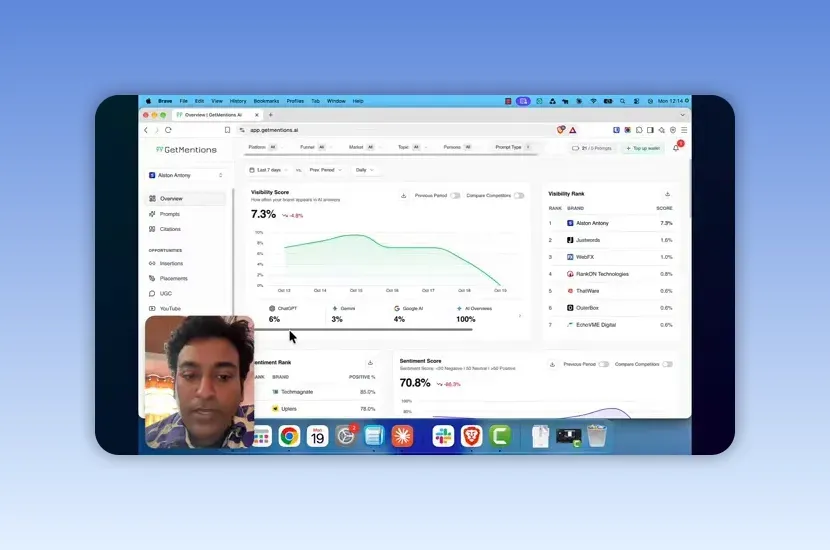
My visibility score read 7.3% on the day of this screenshot. Google AI Overviews was my strongest platform at 100% and Gemini the weakest at 3%, with ChatGPT at 6% and Google AI at 4%. My brand ranked first in the visibility ranking, ahead of Justwords at 1.6% and WebFX at 1.0%. That only holds within this campaign and these prompts, not across the whole market.
The outreach follow-up mattered as much. I had requested two insertions, one placement and one YouTube opportunity. Team members were assigned and quotes appeared in Manage Orders. From there I could approve and pay, reject an offer or message the team about the details. There is also a wallet top-up.
My test reached the quotation stage. I didn’t complete a paid placement, so I haven’t shown any visibility gain caused by one.
How much does GetMentions AI cost?
On 5 November 2026, GetMentions AI’s pricing page listed four plans with a daily or weekly refresh. Every plan includes every feature and unlimited users. Plans differ on prompts, brands, markets, refresh and platforms.
| Plan | Prompts | Brands | Markets | Daily refresh | Weekly refresh |
|---|---|---|---|---|---|
| Starter | 50 | 1 | 1 | $85/mo | $25/mo |
| Growth | 100 | 2 | 3 | $155/mo | $45/mo |
| Pro | 200 | 3 | 5 | $289/mo | $80/mo |
| Scale | 350 | 5 | 10 | $479/mo | $135/mo |
Each plan covers any 4 of 6 standard AI platforms, and you choose which 4. The page lists a 7-day free trial on every plan with no credit card, limited to 25 prompts per run, and says annual billing gives one month free. There is also a custom Enterprise plan.
The outreach quotes are separate from these plan prices. You review each one in Manage Orders, where you can approve and pay, and there is a wallet top-up. You can start from the GetMentions AI deal page (affiliate link) or the plain getmentions.ai site.
What I liked and what I didn’t
What I liked:
- Funnel stage, persona and brand-name controls for the tracked prompts.
- Reading the actual answers behind a visibility score.
- The citation report that turns a missing mention into a list of sources to investigate.
- Insertion, placement and YouTube requests sitting next to the data that found them.
What I didn’t, or couldn’t judge:
- Tracking needs time, and movers and trends were not meaningful in the first week.
- Every outreach request goes through people, so it isn’t instant.
- Placement costs have to be reviewed separately from the plan.
- I didn’t establish a return on any spending.
Which other AI visibility tools did I review?
If you only want tracking, two other tools I tested are worth a look. My Visby AI review covers a tracker that shows the real ChatGPT, Gemini and Claude answers next to their citations. My Knwn review is a young-site test where the prompt tracking held up and the scores needed checking.
Should I use GetMentions AI?
Yes, if you want AI visibility data and help asking for mentions in the sources AI answers already cite. The value is having tracking, citation research and outreach in one place.
No, if you only need to know whether your brand shows up. The outreach is a separate cost, and I didn’t prove it pays back. Judge each opportunity on relevance, price and what is actually being offered. Before paying, I’d use the free trial, track a trimmed prompt list for a week, then look only at the citation gaps that matter for my business.
FAQ
Does GetMentions AI publish my brand on other sites automatically?
No. In my test every insertion, placement and YouTube request was handled by the GetMentions team, which acted as the go-between with the publisher.
Can I try GetMentions AI before paying?
Yes. On 5 November 2026 the pricing page listed a 7-day free trial on every plan, with no credit card and up to 25 prompts per run.
Did paid placements improve my AI visibility?
I don’t know. My test reached the quotation stage, and I didn’t complete a paid placement.
Keep reading
You Might Also Like
Visby AI Review: Tracking My Brand Across AI Answers
My Visby AI review. Real ChatGPT, Gemini and Claude answers and citations per prompt, competitor share of voice, GA4 traffic and a beta report builder.
10 min read
Knwn Review: AI Prompt Tracking Tested on a Young Site
My Knwn review from a test on zplatform.ai. Prompt tracking was the useful part; the scores, citations and gap ideas needed checking against the answers.
9 min read
Morningscore Review: Gamified SEO Missions and AI Tracking
My Morningscore review from a test on zplatform.ai. SEO missions with guides, 953 keyword ideas, daily rank tracking, ChatGPT prompt tracking and AI fixes.
9 min read