SEO Tool Reviews
Knwn Review: AI Prompt Tracking Tested on a Young Site
My Knwn review from a test on zplatform.ai. Prompt tracking was the useful part; the scores, citations and gap ideas needed checking against the answers.

In this Knwn review, I tested an AI search visibility tool on zplatform.ai, one of my own sites, to see whether its scores, citations and prompt tracking gave me something to act on. Prompt tracking was the most useful feature: it works like rank tracking for AI answers. The visibility score, citation counts and gap recommendations were only useful once I read the prompt and answer behind them. This was a first test, not months of use.
Affiliate disclosure: links marked “affiliate link” earn me a commission if you buy, at no extra cost to you. That didn’t change what I wrote. How I review tools. I got access while a lifetime deal was available and recorded this test in November 2025. Prices were checked on 27 September 2026.
Prefer to watch? Here is the full test.
Jump to a part of the video:
- 00:58 Project setup
- 01:47 AI visibility score
- 04:09 Citation analysis
- 05:15 AI visibility gaps
- 09:54 AI prompt tracking
- 12:06 AI search trends
How do you set up Knwn?
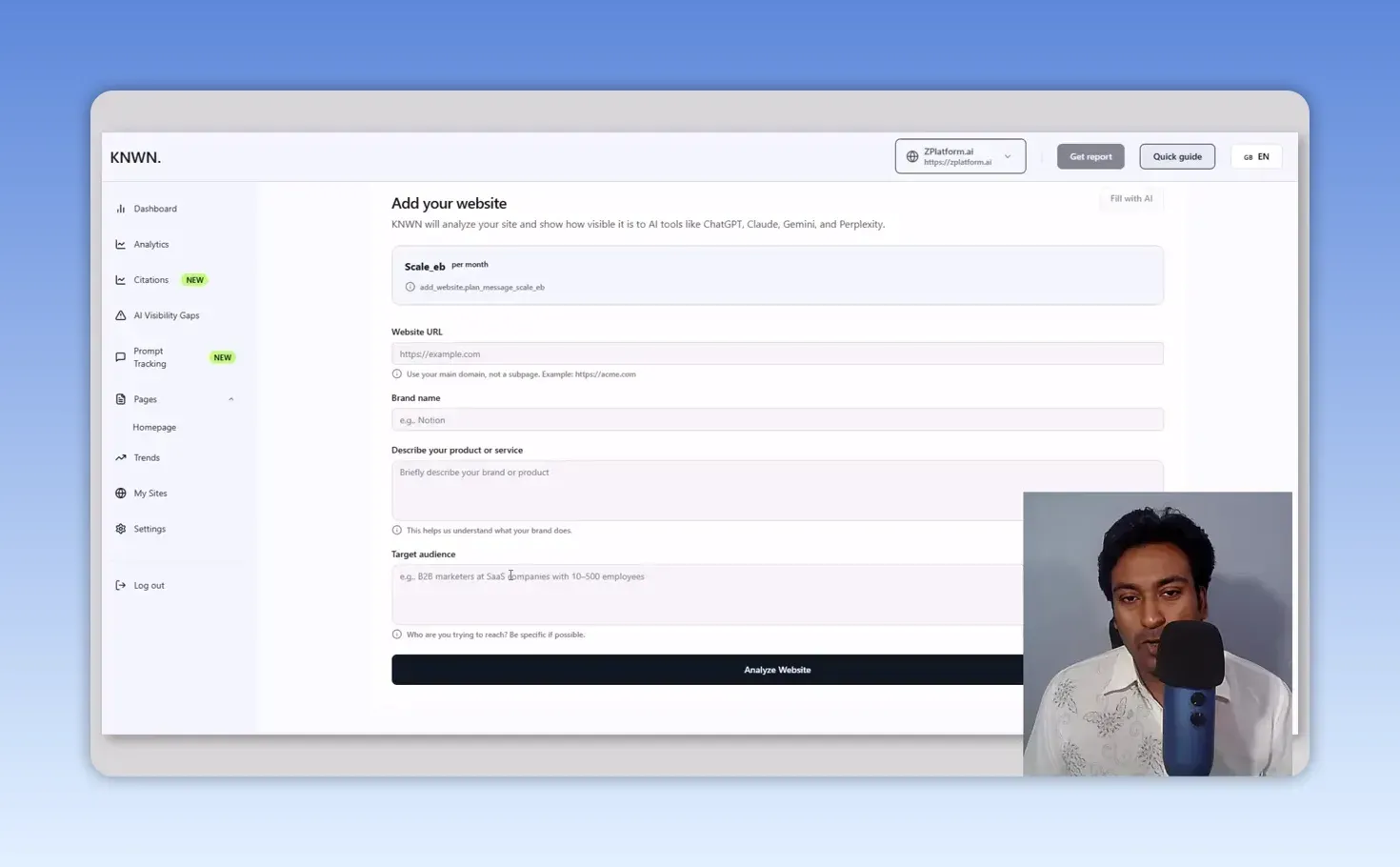
Through a setup wizard that asks for your website URL, brand name, a description of the product or service, and the target audience. My test project was zplatform.ai, an AI tools site focused on lifetime deals and discounts (here is how it grew), and it was still a young site at the time.
Be as accurate and detailed as you can here, and don’t rush it. Everything else in the tool depends on these answers, and a broad description gets you broad recommendations. “AI tools” is not the same as “lifetime deals on AI tools”, and that difference mattered later.
What does the AI visibility score tell you?
Not much on its own. Once the site was added, the dashboard showed an AI visibility score of 35.0, marked low, and an audience score of 90, marked a perfect match. The low visibility didn’t surprise me for a young site. Around the score it showed 8 mentions and noted that a competitor was mentioned first.
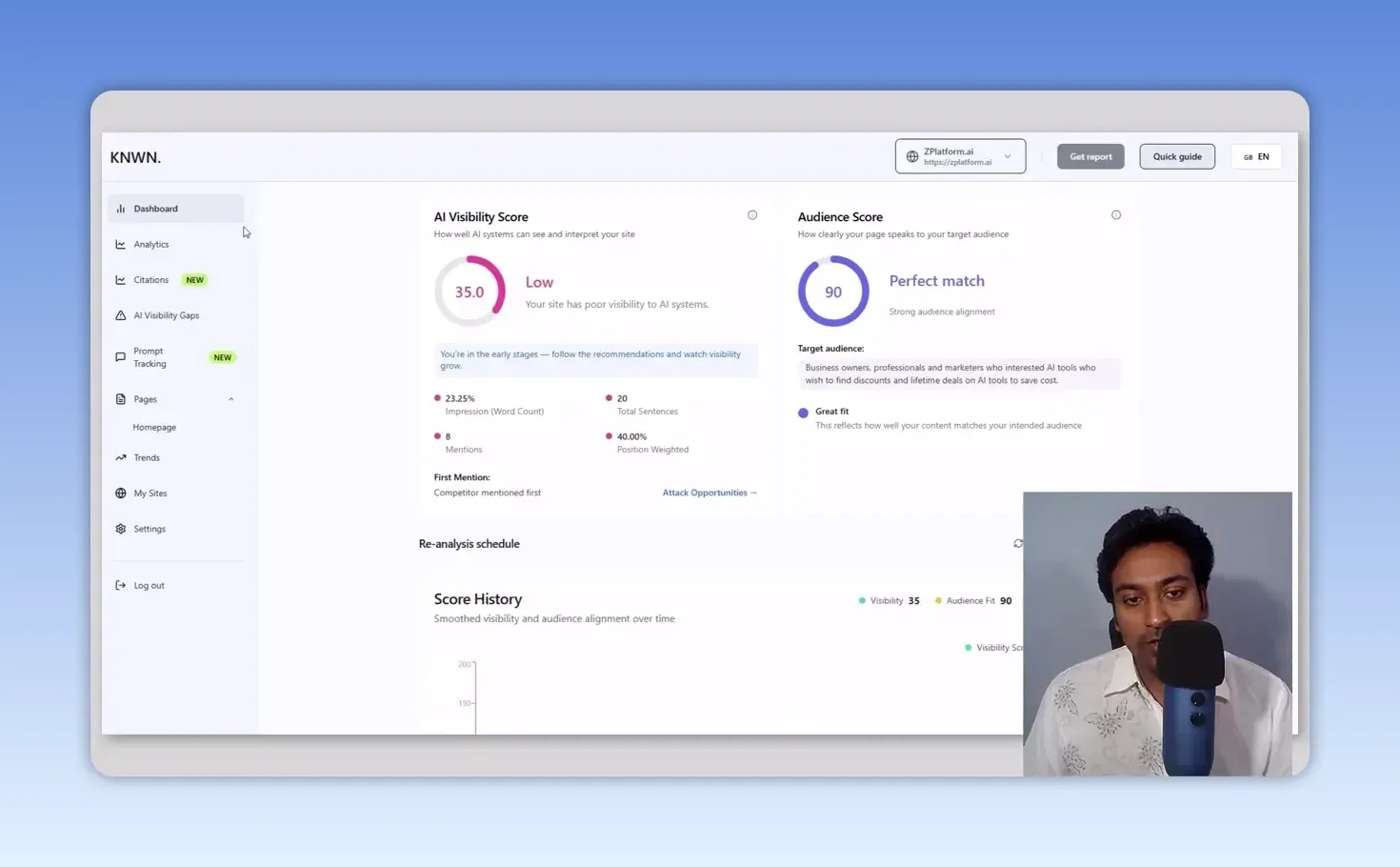
A score is a starting point, not a decision. I want to know which questions produced it, what the AI answered, and whether it understood my business. The audience score needs the same context: it measures how well the site fits the audience you typed in, so a vague audience description makes it less meaningful.
I don’t think SEO and AI SEO are separate worlds. Explaining clearly what your site does and who it helps still matters in both.
Can Knwn show traffic and citations from AI platforms?
Partly. Knwn gives you a tracking script so visits from AI platforms show up in its own analytics area, which is handy if you want them next to your other AI visibility reports. Depending on your setup, you can also find those referrals in Google Analytics traffic acquisition reports or build your own report in Looker Studio.
The citation analysis shows how often the brand appears in AI answers and the related URLs. I could see mentions, but I wanted more depth here. Which prompt led to a citation? What was the full answer? What could I realistically improve? A count alone doesn’t answer those.
I also saw cases where Knwn seemed to misread the brand and pulled in other brands. Check each result before treating a citation count as proof your positioning works.
Are the AI visibility gap recommendations useful for a small niche?
Only when the prompt fits the niche. The gap report tests several kinds of question: brand recall, listicle queries, audience fit, use-case fit and competitor comparisons. For each it shows the prompt, the AI response and a suggested action, and I give it credit for showing the actual prompt, because that lets me judge whether the test makes sense for my business.
One listicle prompt was a good fit: “What are the most effective platforms for business owners and marketers seeking discounts and lifetime deals on AI tools?” The answer led with AppSumo, and Knwn marked my brand as missing, with AppSumo, SaaSpirate, PitchGround, StackSocial and Futurepedia as the competitors. Its suggested action, an article explaining what my platform offers against those competitors, was a reasonable idea.
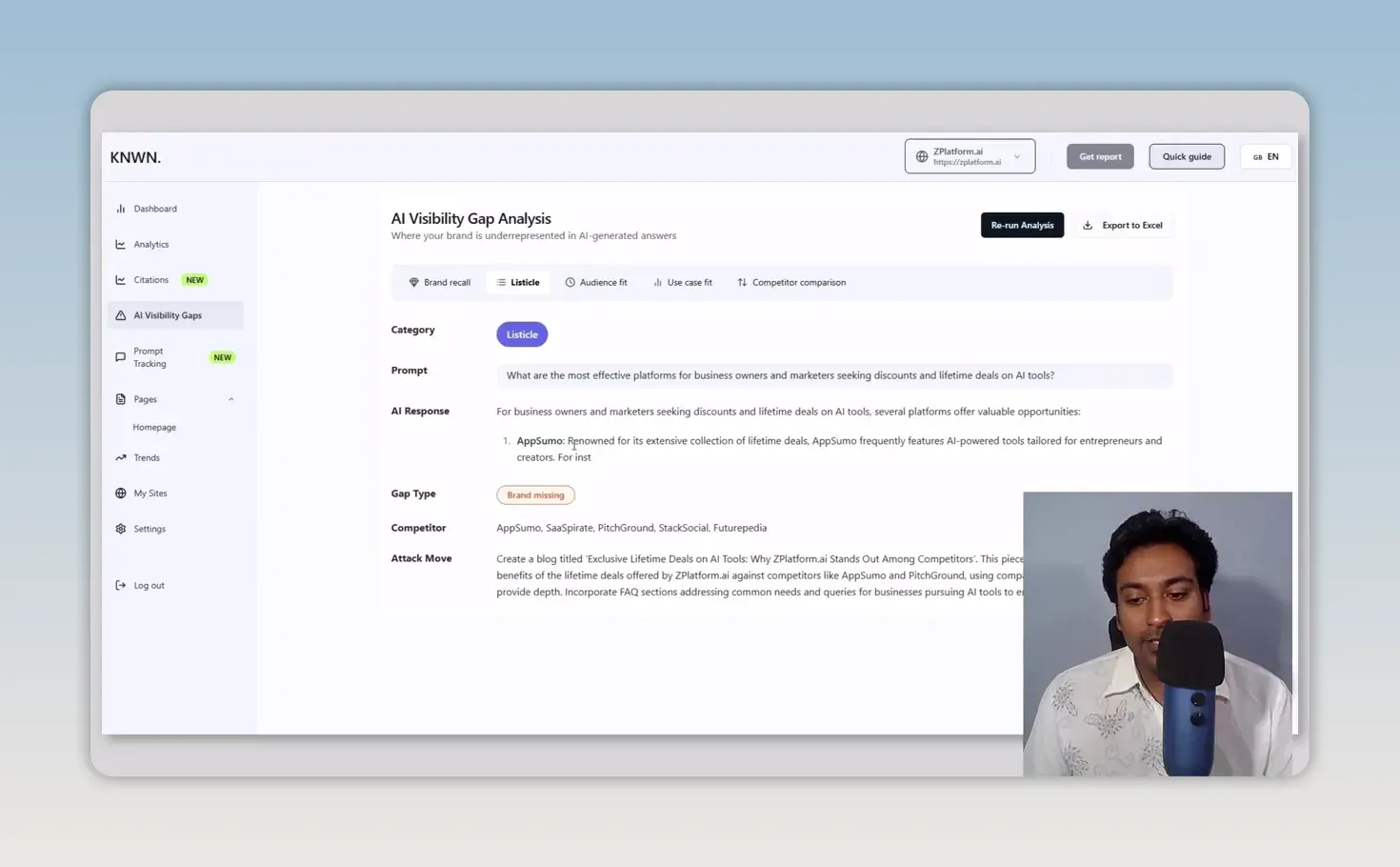
Other prompts missed the point. Some treated my site as a general AI tools platform, and one steered towards general savings and deals sites rather than my actual niche, then gave me ideas based on the wrong comparison. I wouldn’t write a post just because a gap report suggested it. First ask: would my audience ask this, and did Knwn understand what I sell?
You can run similar questions yourself in an AI chatbot if you know what to ask. Knwn’s value is putting the prompts, responses and possible actions in one organised view. Choosing the questions worth asking still takes keyword and audience research; my ChatGPT prompts for keyword research and my BuzzAbout review cover both sides of that.
Why was prompt tracking the most useful feature?
Because it answers a specific question every day instead of giving one overall score. I think of it as rank tracking for AI search:
- In traditional SEO, you track a keyword and its position in Google.
- In AI search, you track a prompt and whether the answer mentions your brand, cites your site or mentions a competitor.
You enter a question you care about, pick an AI model, and Knwn re-runs it daily. There are suggested queries and bulk import too. My plan allowed 50 tracked prompts. For each one you can review mentions, citations, the model and the full response, instead of asking the same question by hand every day.
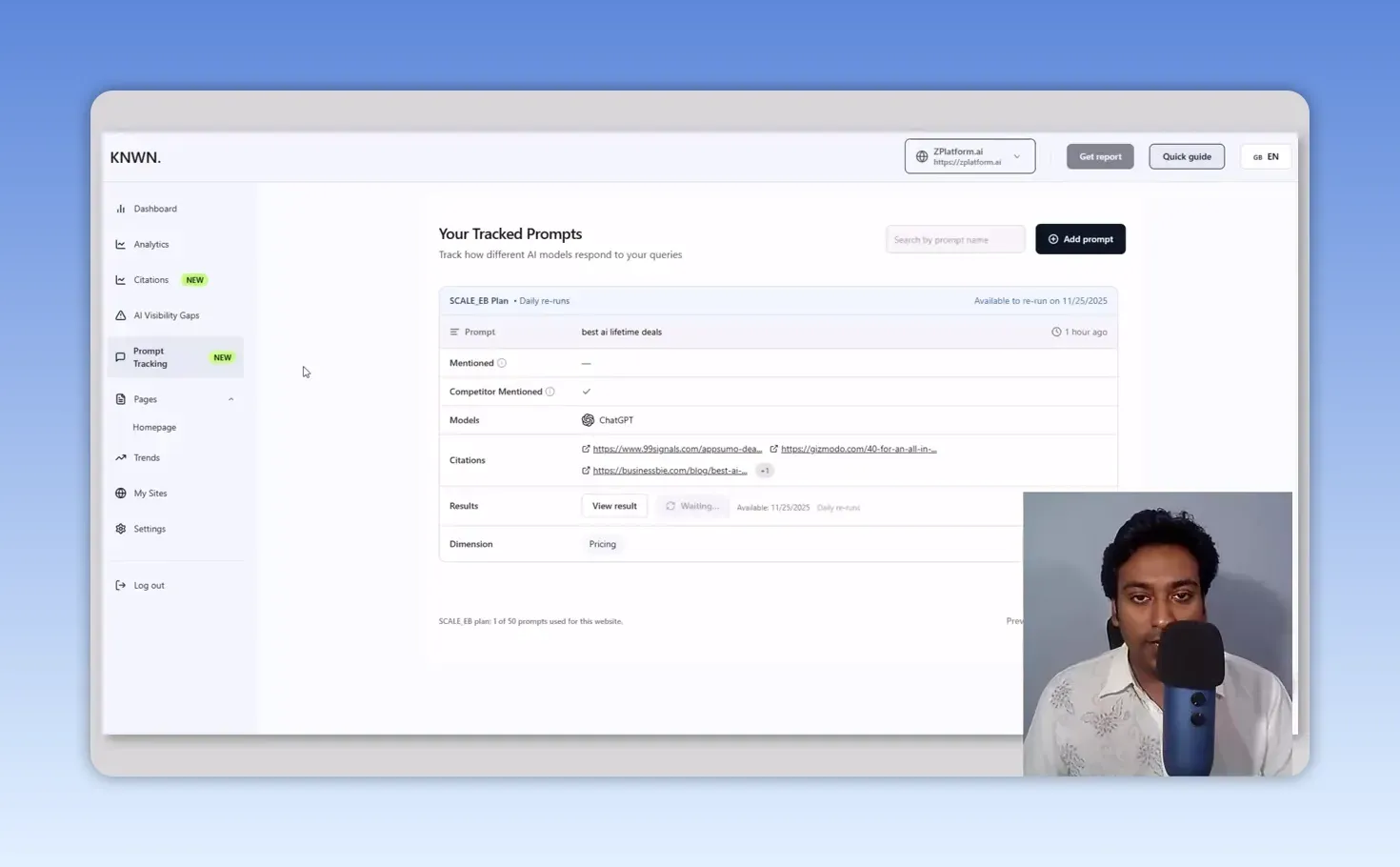
I tracked “best ai lifetime deals” on ChatGPT. My brand wasn’t mentioned, a competitor was, and the answer cited sources such as 99signals and Gizmodo. That is far more meaningful for zplatform.ai than a general question about AI tools: I have a specific result to investigate, and if the brand appears later I can read the answer and check it describes the business correctly.
Choose prompts carefully instead of filling every slot. Start with the questions that reflect your product and audience, then review the responses over time.
What about page visibility and AI search trends?
Not enough to judge yet. You can add individual pages for visibility analysis using the page path and title; I saw how to add them but didn’t test this enough to rate it.
The trends section tries to surface growing questions in a niche. For my micro niche it was hit and miss: only a small set of questions, several only loosely related to AI lifetime deals, and the demand and growth figures didn’t give me a strong reason to pursue them. I’d like to click into a promising question and explore it in more depth before deciding to write about it.
How much does Knwn cost?
On 27 September 2026, Knwn’s pricing page listed three monthly plans, now under the name KNWN Visibility:
| Plan | Price | Tracked prompts | Brands |
|---|---|---|---|
| Pro | $49/mo | 10 | 1 |
| Growth | $99/mo | 25 | 2 |
| Scale | $199/mo | 50 | 5 |
I tested on a lifetime deal mapped to the Scale plan, which is where my 50 prompts came from. On 27 September 2026 the Knwn lifetime deal page (affiliate link) was marked sold out.
What I liked and what I didn’t
What I liked:
- Prompt tracking re-runs your own questions daily and shows mentions, citations, competitors and the full answer.
- The gap report shows the exact prompt behind each recommendation.
- Analytics for visits from AI platforms sit next to the visibility reports.
What I didn’t:
- Citation counts lacked the prompt and answer context I wanted.
- It sometimes misread the brand and pulled in other brands.
- Gap recommendations and trends drifted away from a narrow niche.
- Page visibility is something I haven’t tested enough to judge.
Is Knwn worth considering as an AI SEO tool?
As a dedicated place to track AI search prompts, yes, that is a good starting point. The citation reports and visibility gaps can give you ideas, but always read the actual prompt and response, and expect a narrow niche to need more care. I heard the team was working on more competitor tracking, and comparing the questions where competitors appear would make it much more useful.
My workflow is simple: choose the important prompts, track brand mentions and citations, read the responses, and check what changes over time. If you want the same kind of tracking with competitor share of voice and a report builder, my Visby AI review covers that tool.
An AI mention isn’t the end goal. What matters is whether that discovery brings relevant traffic, signups or customers. Knwn can show part of that journey, but I wouldn’t buy it to improve a dashboard score. For how AI search picks its sources in the first place, start with my AI SEO guide.
FAQ
Does Knwn replace traditional SEO tools?
No. Its prompt tracking is an extra way to measure AI search mentions and citations alongside normal SEO work.
Should I trust the overall AI visibility score?
Use it as an overview only. The prompts, answers and brand context behind the score are what tell you what to do next.
Pick five prompts your customers would really ask, track them for a month, and read every answer. The lifetime deal is sold out as I write; if it returns it will be on the Knwn deal page (affiliate link), and the monthly plans are on Knwn’s pricing page.
Keep reading
You Might Also Like

Visby AI Review: Tracking My Brand Across AI Answers
My Visby AI review. Real ChatGPT, Gemini and Claude answers and citations per prompt, competitor share of voice, GA4 traffic and a beta report builder.
10 min read
Morningscore Review: Gamified SEO Missions and AI Tracking
My Morningscore review from a test on zplatform.ai. SEO missions with guides, 953 keyword ideas, daily rank tracking, ChatGPT prompt tracking and AI fixes.
9 min read
ClickRank Review: Strong AI Agent, Weak AI Writer
My ClickRank review from a test on my own WordPress site. The Search Console AI agent impressed me, one-click titles worked, and the AI writer failed.
11 min read