SEO Tool Reviews
Morningscore Review: Gamified SEO Missions and AI Tracking
My Morningscore review from a test on zplatform.ai. SEO missions with guides, 953 keyword ideas, daily rank tracking, ChatGPT prompt tracking and AI fixes.

In this Morningscore review, I tested the tool on zplatform.ai, one of my own sites (here is how it grew), and found an all-in-one SEO platform that turns the work into missions with a guide for each. Keyword research, daily rank tracking, backlinks, site audits and AI search tracking all sit under that game layer. It suits beginners and business owners who want to know what to do next more than people who want the deepest dataset.
Affiliate disclosure: links marked “affiliate link” earn me a commission if you buy, at no extra cost to you, and my exclusive code growth2026 gives you 20% off. Neither changed what I wrote, including the parts I haven’t tested enough to judge. How I review tools. I recorded this test on 17 March 2026. Prices were checked on 24 September 2026.
Prefer to watch? Here is the full walkthrough.
What makes Morningscore different from other SEO tools?
The game layer. Morningscore calls its dashboard mission control, with space-themed levels, missions and XP, and underneath it is a full SEO tool. The main sections are Overview, Research, Tracking, Links, Health, Missions and Automation.
I first looked at Morningscore about five years ago. My impression hasn’t changed: it takes a different approach from data-heavy platforms such as Semrush and Ahrefs, and it is built for people who open an SEO tool, see too much data, and don’t know what to do next.
You can open the Morningscore live demo without registering. Do that before anything else, because whether the interface suits you decides whether the rest matters.
How do the SEO missions decide what I work on next?
Missions turn SEO into specific tasks. Instead of only showing my link score or a keyword position, Morningscore lets me pick goals for rankings, links and site health, add them to a list, refresh their status and see which ones I have finished.
zplatform.ai was at Level 2, Moon camp, with Lift off behind it and the later stages locked. Finishing SEO work earns XP and moves the bar. It is a small psychological nudge, but I can see it keeping a beginner going.
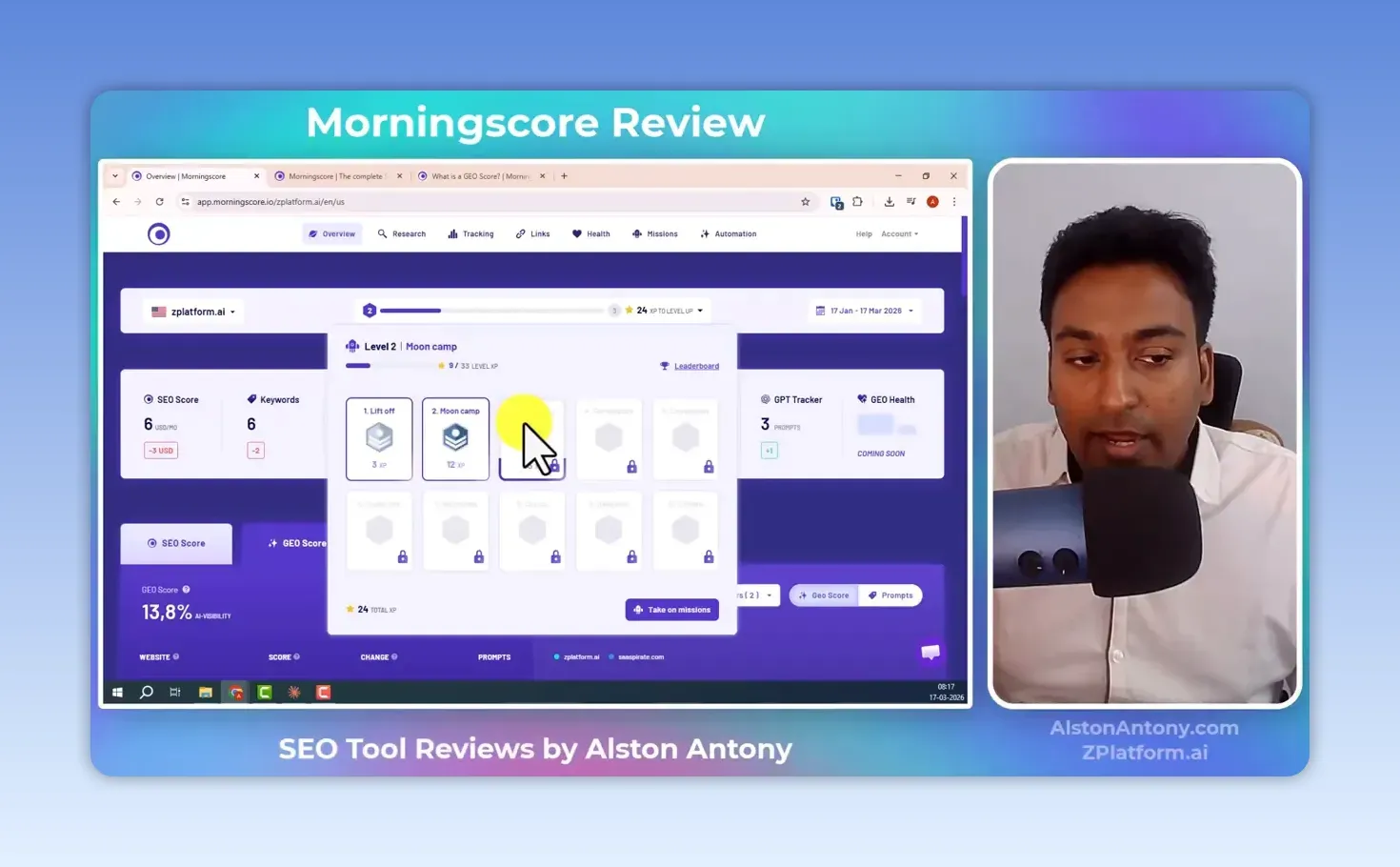
A mission is more than a badge. Open its guide and you get what the task means and the steps to do it; a link mission, for example, comes with suggestions for where links could come from. The task plus the guide is what makes the system practical rather than decoration.
What does the Overview dashboard show?
A summary of the site: SEO score, keywords, technical and on-page health, link score and tracked rankings. I can add competitors and compare visits, keywords and score against mine.
There is a GEO side too, for AI search visibility, including Google AI visibility and the tracked prompts where my brand appears. In my account the GEO score read 13.8% AI visibility, and the GEO Health card was marked “coming soon”, so parts of this area are still being built. I wouldn’t treat every GEO feature as finished, but checking traditional SEO and AI visibility in one place is useful.
How good is the keyword research and rank tracking?
Good enough for finding opportunities. A search for “ai tools” returned 953 keyword ideas. I could sort and filter them, see search volume, CPC and difficulty, save keywords to a list, or export a CSV. A suggested-keywords option uses your own site to propose topics.
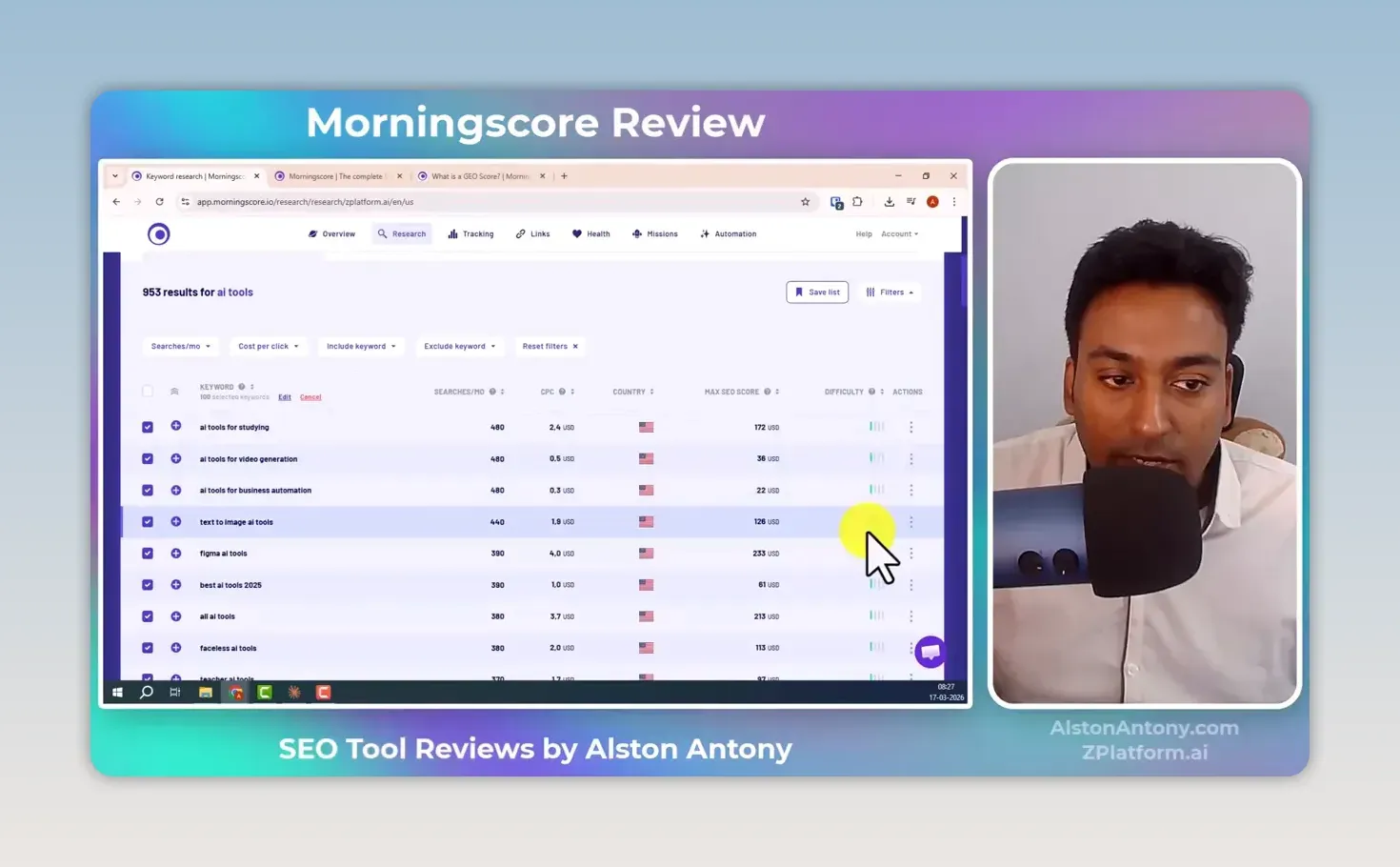
I still judge each keyword against my audience and what I can genuinely write about. My ChatGPT prompts for keyword research cover that part of the process, and for question-led topics my Answer Socrates review shows a tool that goes deeper on one job.
Research and tracking are separate. Research finds opportunities; the Google tracker follows the keywords you choose, with daily updates. You can organise keywords into folders, group rankings by page, look at position history and compare tracked terms with competitors. Connecting Google Search Console brings your own search data in.
Can Morningscore show where my brand appears in ChatGPT?
Yes, and it is the biggest change since I first used it. Prompt research shows each prompt, whether my brand was found, and the result itself, so I can see where it appeared. In one example my brand was found in 25 of 111 prompt lookups. I can also track important prompts and follow changes in the ChatGPT tracker.
The percentage matters less than the detail behind it: which prompts mention my site, which sources are shown, and where competitors appear instead. That points at the content I may need to improve. If AI visibility is the main thing you need tracked, my Visby AI review covers a tool built only for that.
What does the Links section tell me?
It shows my link score, every backlink found, competitor links, and new and lost links. When I lose a link I can see where it was and decide whether it is worth getting back. I can also submit a new link for scanning after I build it.
Morningscore flags spam-related links and has link missions too. In my account the backlink data was credited to Moz, which is worth knowing if the numbers differ from another backlink tool you use. Morningscore’s own pricing page says it collects data from seven partners overall.
How does Morningscore find and fix technical issues?
The Health section crawls the site and reports basic, technical and content issues. It keeps audit history, so new problems show up as new instead of the whole list starting again. You can also open single landing pages to see their scores and the on-page or technical work each needs.
On a broken external link issue, the AI fix suggested replacement links. On a missing alt tag, it generated alt text and told me how to apply it. The fix guide also warned that the page hadn’t been scanned for 127 days and offered a fresh landing page scan for better suggestions.
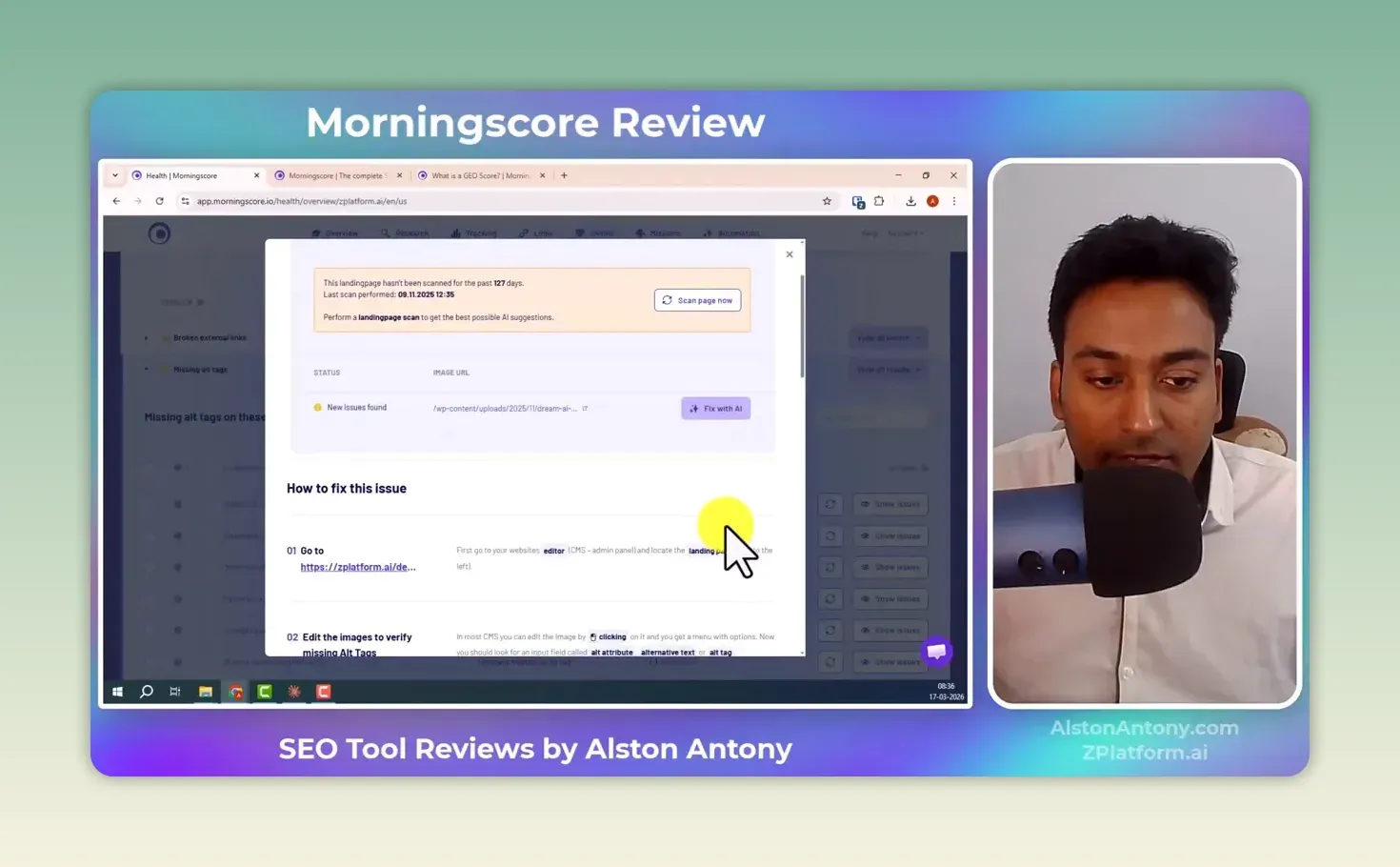
I check any suggested replacement before changing the site. What I like is that it explains the problem as well as proposing the fix.
Should I use the AI article generator and integrations?
I can’t recommend the article generator yet, because I haven’t tested it enough. Automation includes it: give it keywords and instructions, and it writes. I generated one article. It tried to include internal links and branded elements from my site, which is a good sign, but I haven’t judged the quality or accuracy. A one-click article isn’t how I work anyway; I research, outline and place internal links myself.
The tools area also has GEO analysis, a WordPress plugin, a Shopify app and an API. GEO analysis produces a report covering SEO content, links and brand mentions. The WordPress plugin brings health issues and AI-assisted fixes into the site itself. I haven’t tried the Shopify app, so I have no verdict on it.
How much does Morningscore cost?
Plans start at $69 a month. Every plan includes the same feature set; the tiers change how many users, websites, keywords, tracked prompts and AI credits you get.
| Plan | Price | Users | Websites | Keywords | Tracked prompts | AI credits |
|---|---|---|---|---|---|---|
| Lite | $69/mo | 2 | 3 | 100 | 10 | 100 |
| Business | $99/mo | 4 | 10 | 500 | 100 | 1,000 |
| Pro | $159/mo | 10 | 30 | 2,000 | 500 | 5,000 |
| Premium | $299/mo | 20 | 100 | 5,000 | 2,000 | 20,000 |
Prices are excluding VAT, from Morningscore’s pricing page on 24 September 2026. Paying yearly gives two months free, and there is a 14-day free trial without a credit card. My exclusive code growth2026 takes 20% off.
What I liked and what I didn’t
What I liked:
- Missions make the next task obvious, and each comes with a guide.
- Traditional SEO and AI search visibility sit in one dashboard.
- The AI fix explains an issue as well as suggesting a change.
- You can try the live demo without signing up.
What I didn’t, or couldn’t judge:
- Parts of the GEO area were still in development; GEO Health was marked “coming soon”.
- If you need the deepest possible datasets, specialised tools go further.
- I haven’t tested the AI article generator enough to judge it, or tried the Shopify app.
Who should use Morningscore?
Someone who wants an all-in-one SEO tool that makes the next task clear. Missions, guides and visible progress make it a good fit for beginners and non-technical business owners, and keyword tracking, backlinks, audits and AI search tracking leave room to grow into.
If you need extremely deep data, a data-heavy platform such as Semrush or Ahrefs may still suit you better; my Semrush vs Morningscore comparison puts the two side by side. If traditional dashboards overwhelm you, Morningscore is worth a look.
FAQ
Can I try Morningscore without creating an account?
Yes. The live demo lets you look around the dashboard without registering, and the free trial runs 14 days without a card.
Does Morningscore update rankings daily?
Yes. The Google tracker updates daily for the keywords you choose to track.
Start with the demo and see whether the missions make you want to do the work. If they do, try Morningscore here (affiliate link) and use code growth2026 for 20% off.
Keep reading
You Might Also Like

Visby AI Review: Tracking My Brand Across AI Answers
My Visby AI review. Real ChatGPT, Gemini and Claude answers and citations per prompt, competitor share of voice, GA4 traffic and a beta report builder.
10 min read

Bishopi Review: Domain Research Tools and SEO Data Tested
My Bishopi review from a March 2026 test. Dropped domains, valuation and age history held up; keyword ideas, related searches and backlinks fell short.
10 min read

Semdash Review: Big SEO Database, Metrics to Double-Check
My Semdash review. Competitor, keyword, backlink and traffic research held up; keyword difficulty, some inputs and the AI visibility data needed checking.
10 min read