SEO Tool Reviews
Semrush vs Morningscore: Which SEO Tool Fits Your Business?
Semrush vs Morningscore after using both: keyword depth, backlinks, audits, content tools and price, and which one suits a beginner or an agency.

Semrush vs Morningscore is not a question of which has more features. I have used premium access to both, and they approach SEO very differently: Semrush gives you a huge amount of data and tools, and Morningscore makes SEO easier to understand and keep doing. Choose Semrush for deep keyword, backlink and competitor research or agency work; choose Morningscore if you are a beginner or a small business owner who wants clear next steps. Both handled the main site audit issues well.
Affiliate disclosure: I am an affiliate for both tools, and links marked “affiliate link” earn me a commission if you buy, at no extra cost to you. That didn’t change what I found. How I review tools. I recorded this comparison for a video published on 1 May 2025 and focused on SEO, not every PPC or social feature Semrush has. Prices were checked on 28 September 2026.
This compares the two side by side. For a full hands-on review of Morningscore on its own, including its AI search tracking, see my Morningscore review.
Prefer to watch? Here is the full comparison.
Jump to a part of the video:
- 09:32 Keyword research
- 17:20 Backlink analysis
- 23:30 Site audits
- 28:26 Competitor analysis
- 30:43 Content marketing
- 34:39 Pricing
- 48:25 Which one to buy
How do Semrush and Morningscore compare at a glance?
| Semrush | Morningscore | |
|---|---|---|
| Best for | Agencies, consultants, large sites, SEO as a main channel | Beginners, small businesses, budget-conscious startups |
| Keyword research | Deep: 305,704 ideas for “ipl” in my test | Essentials: about 1,075 results for the same search |
| Backlinks | Large database, audits and link-building tools | Link score, new and lost links, data from Moz |
| Site audits | Detailed issues and fix tracking, plus log file analysis | Health section with step-by-step fixes |
| Content marketing | Content recommendations, outlines and scoring | No comparable module in my comparison |
| Learning | Large Academy, knowledge base and tutorials | Guidance and missions inside the product |
| Free trial | 7 days | 14 days, no card |
How do the two approach SEO differently?
Semrush is for investigating; Morningscore is for acting. In Semrush I move from a domain overview into organic keywords, backlinks, competitor data and technical issues, then filter further. As an experienced SEO, I value that, because data is everything when I need a detailed decision.
I wouldn’t tell a complete beginner they will immediately know where to look, though. Semrush packs a lot into one app, and learning its full potential takes time. It’s a bit like a sports car: knowing how to drive doesn’t mean you know how to get the best out of it.
Morningscore feels different from the moment you open a project. You see a simplified overview, keywords, links, website health and missions. Completed tasks earn XP, and levels and progress nudge you towards the next action, so SEO work becomes a mission instead of another table of numbers.
That simplicity is its biggest strength and its limitation. It suits a small business owner who wants the benefits of SEO without making SEO their job. For someone like me who wants every data point, simplification means less to investigate.
Which gives more useful keyword research?
Semrush, for depth. I can inspect a competitor’s organic keywords, compare two domains in Keyword Gap, study one term in Keyword Overview, and filter a much larger set in Keyword Magic Tool, with volume, difficulty, CPC, questions, ranking pages and country data, then group and cluster the ones I keep.
To make it practical, I searched “IPL” in both. Semrush’s Keyword Magic Tool returned 305,704 broad-match keywords, with more than 22,000 question keywords. Morningscore returned about 1,075 results. Those are the figures from that one example, not a promise that every search will show the same gap.
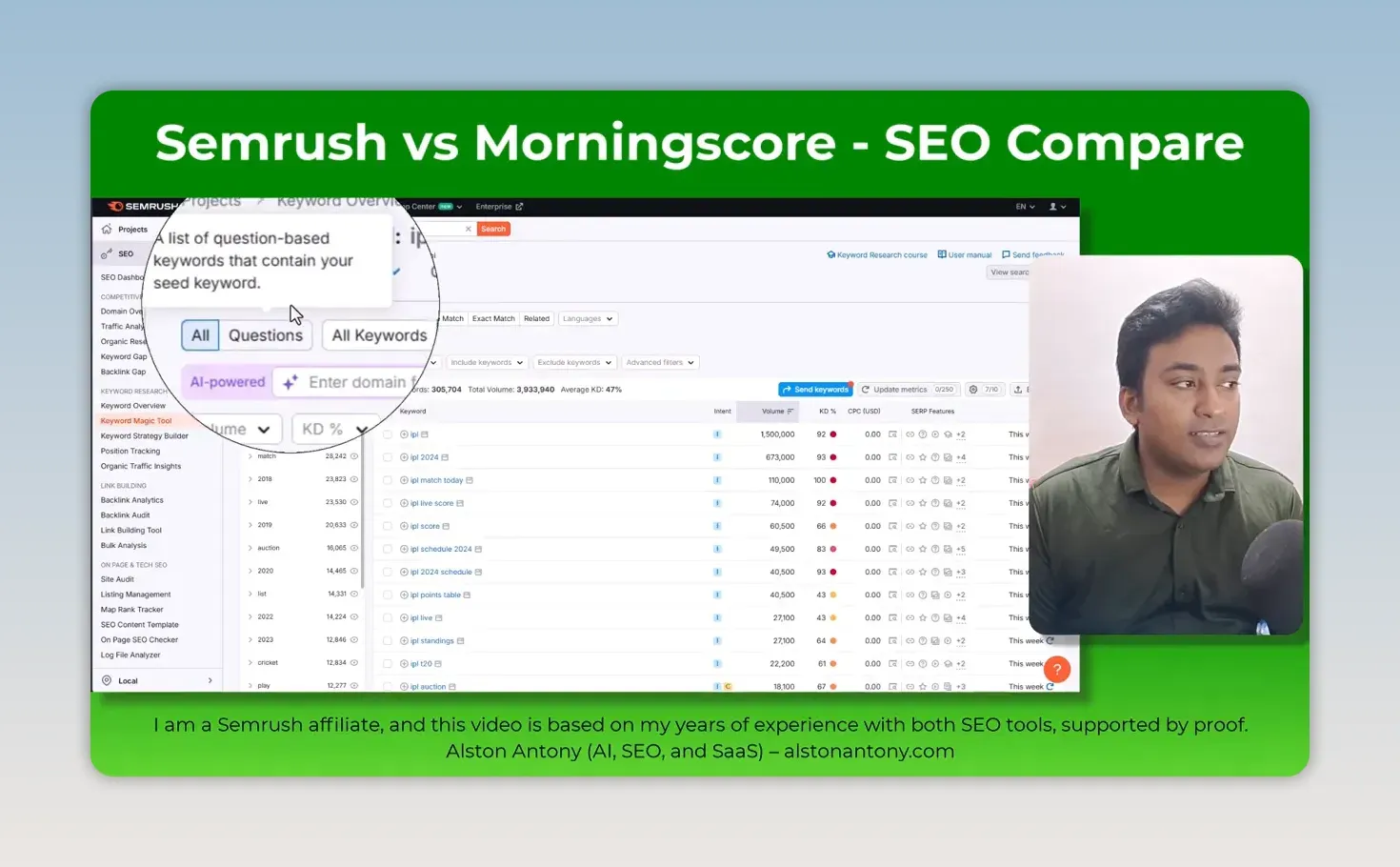
Morningscore still gives you the essentials in a simple table, including search volume and CPC, with options to track a keyword or save it to a list without learning several separate tools first. For the process itself, my ChatGPT prompts for keyword research cover finding ideas, and my Google Keyword Planner guide covers a free source of search data before you pay for either.
Which is better for backlinks and competitor analysis?
Semrush, for professional work. Its backlink analytics covers referring domains, individual backlinks, anchor text and more, and it has backlink audit and link-building tools for investigating a site or managing outreach. The database size and filters matter when you research competitors or work on client SEO.
Morningscore shows a link score and lets you inspect links, including new and lost backlinks, with the link data provided by Moz. It is much simpler, and viewing backlink details can use link credits. That may be enough if you just want to know your link profile is moving the right way.
Don’t judge a backlink tool by its advertised database size alone. Enter the same domains in both and check which backlinks each finds for the sites that matter to you. What I find for my sites may not match what you need for yours.
The same difference shows in competitor research. In Semrush you enter a domain and go straight into organic search or backlink details. In Morningscore you add a competitor to a project, then explore its keywords and links through the relevant sections. It works, but if competitor research is a regular part of your job, Semrush is more useful.
Do you need Semrush for technical SEO audits?
Not necessarily. This was the closest part of the comparison: both found the main kinds of issue I wanted to check. Technical SEO is mostly about specific conditions, such as missing alt text, heading problems or redirects, not a huge keyword database.
Semrush Site Audit gives detailed issues and a way to follow what has been fixed over time, plus specialised tools such as log file analysis when you need to investigate crawling. Morningscore puts issues in its Health section with a cleaner view of what needs attention.
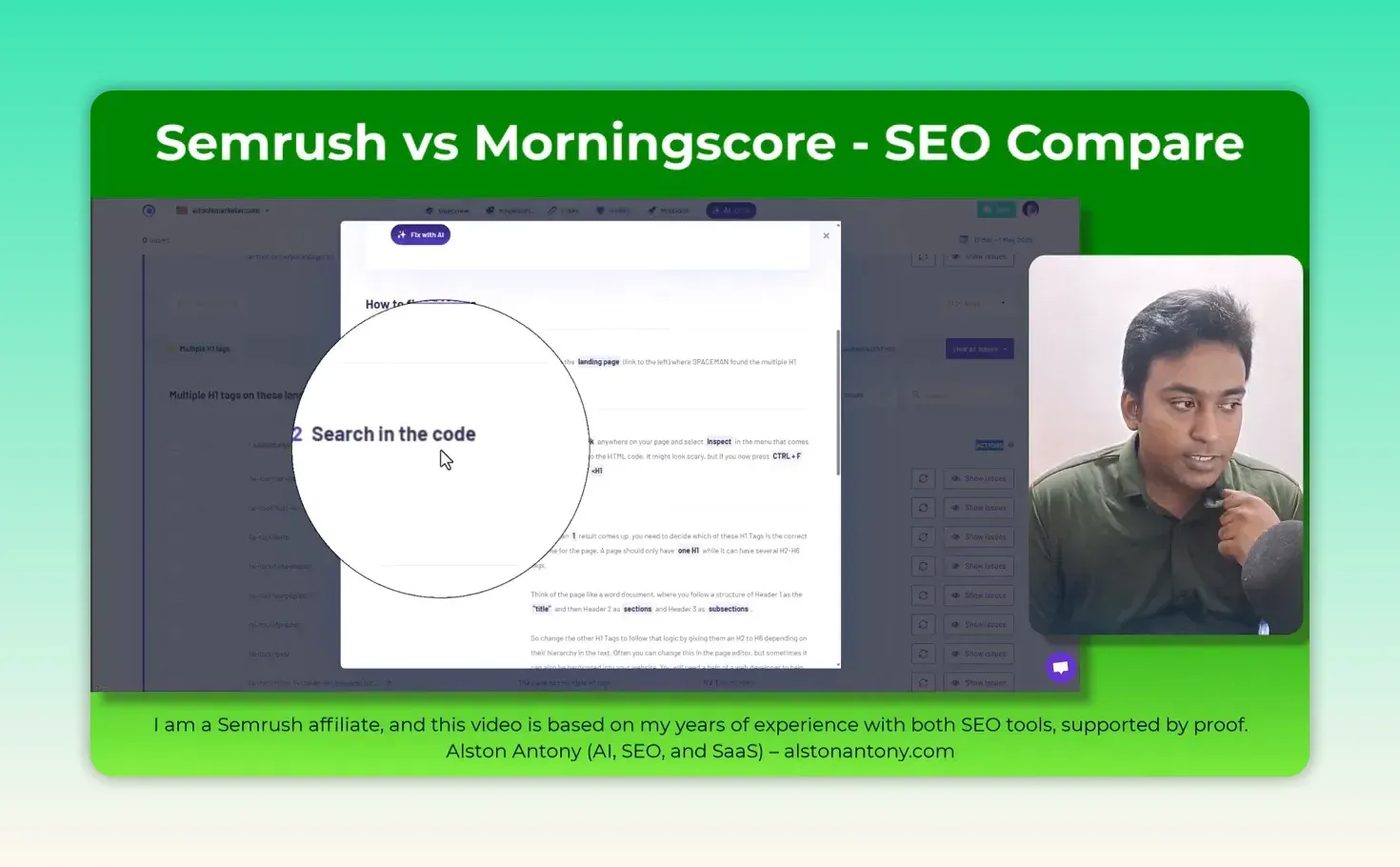
For a beginner, those explanations make a real difference. When I opened a multiple-H1 issue, Morningscore showed the steps to fix it. I wouldn’t pick a winner for basic audits; I’d pick the interface that makes you more likely to actually fix the problems.
What if content marketing is part of your SEO?
Then Semrush has the clearer advantage. Its content tools give recommendations, outlines and content scoring alongside keyword research. Morningscore’s main sections are keywords, links, health and missions, and it didn’t have a comparable content marketing module in my comparison.
If content is central to how you grow search traffic, that gap matters. If you mainly track a few keywords, check site health and want to stay motivated to finish SEO tasks, it may not matter at all. Decide on the work you will do every week, not on a long feature list you may never use.
How should you compare the pricing?
By the limits that match your work, not just the entry price. When I recorded this, Semrush started at around $119 a month, and Morningscore at $49 with a $69 plan above it. Both have changed since.
On 28 September 2026, Semrush’s pricing page showed me prices in euros: an SEO plan at €134 a month (€112.52 a month billed annually), and combined SEO and AI Search plans from €190 a month, plus a free plan and a seven-day trial. Morningscore’s pricing page listed Lite at $69, Business at $99, Pro at $159 and Premium at $299 a month, excluding VAT, with a 14-day trial and no card.
Semrush plans limit things such as results and tracked keywords, and some advanced features cost extra. Morningscore asks you to think in websites, keywords and users per plan instead.
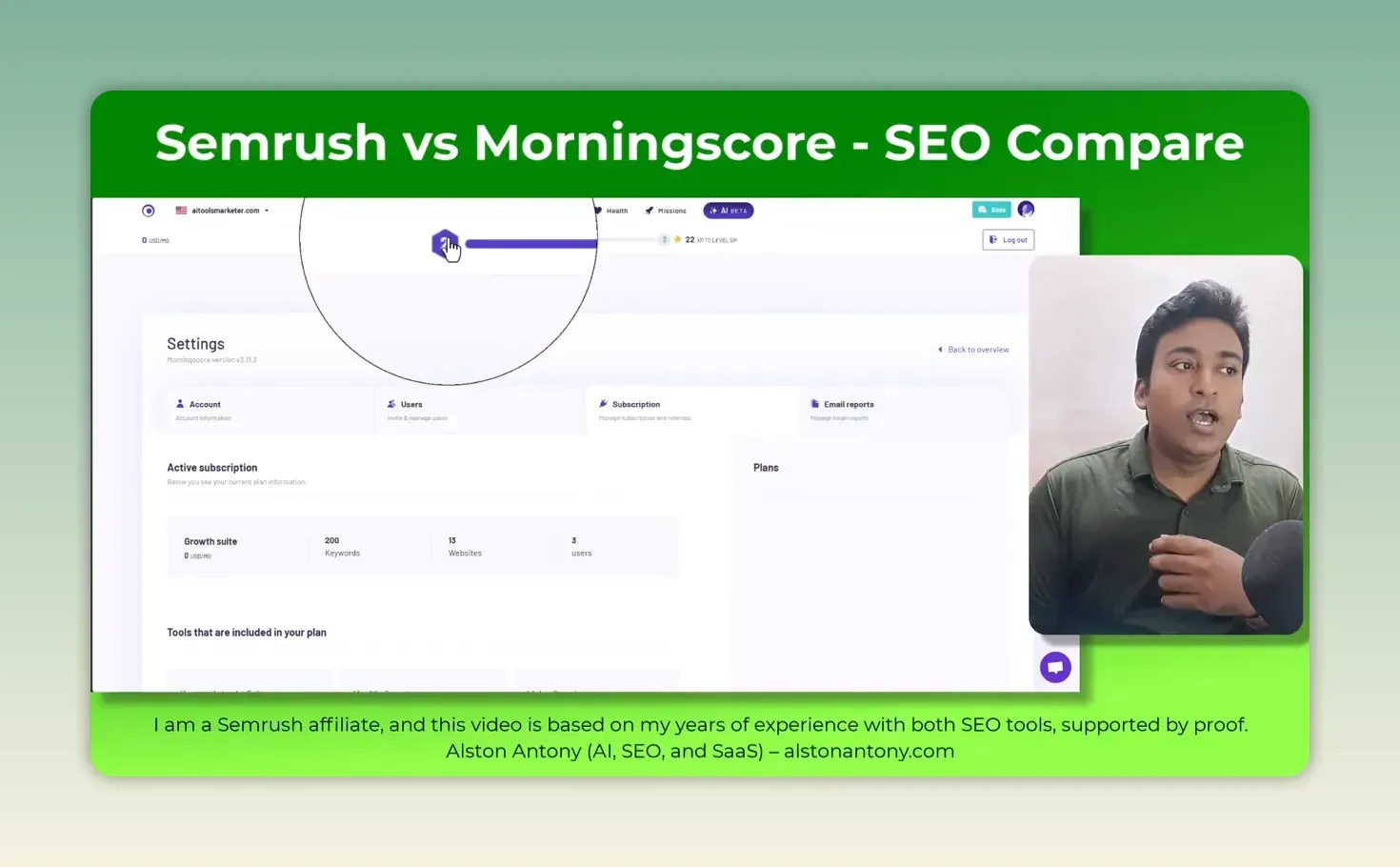
Compare those limits against your own projects, especially if you manage several clients. Learning resources count too: Semrush has a large Academy, knowledge base and tutorials, which you will need because there is so much to learn, while Morningscore teaches through help material and its missions as you work.
Which should you choose?
Choose Semrush for an SEO agency, a consultant, a large website, or a business where organic search is a main marketing channel. It suits deep keyword and backlink research, advanced competitor analysis and a wider set of digital marketing tools. The costs are a higher price, a steeper learning curve, and feature overload when you only need a simple answer.
Choose Morningscore if you are a beginner, a budget-conscious startup or a small business owner who wants a gentle way into SEO. Missions also help a team divide tasks and see progress. The trade-off is less data depth and fewer advanced features, particularly for content marketing and agency-style work.
If you want Semrush-style research without the Semrush price, my Semdash review covers a budget alternative and which of its numbers to double-check. For my verdict on Semrush on its own, tool by tool, see my Semrush review.
How should you test both before paying?
Use the trials on the same website, keywords and competitors in each: seven days for Semrush and 14 for Morningscore. Check the data you get, the work you can finish and whether you feel like coming back to the tool, and note when each trial ends if you don’t want to continue.
Then start with the lowest plan that covers your needs and move up when your actual work requires it. Neither tool is bad at what it sets out to do. If you are starting out, Morningscore may help you build the habit; if you later need more data, Semrush may be the next step.
Try Semrush here (affiliate link) or try Morningscore here (affiliate link); my exclusive code growth2026 takes 20% off Morningscore.
Keep reading
You Might Also Like

Semrush Review: Every Major Tool Tested, and Is It Worth It?
My Semrush review after using every major tool: keyword research, site audits, backlinks and PPC, what I would skip, pricing, and who should pay.
28 min read

Bishopi Review: Domain Research Tools and SEO Data Tested
My Bishopi review from a March 2026 test. Dropped domains, valuation and age history held up; keyword ideas, related searches and backlinks fell short.
10 min read

Semdash Review: Big SEO Database, Metrics to Double-Check
My Semdash review. Competitor, keyword, backlink and traffic research held up; keyword difficulty, some inputs and the AI visibility data needed checking.
10 min read