SEO Tool Reviews
Semdash Review: Big SEO Database, Metrics to Double-Check
My Semdash review. Competitor, keyword, backlink and traffic research held up; keyword difficulty, some inputs and the AI visibility data needed checking.

In this Semdash review, I tested whether a budget all-in-one SEO tool can do the research I normally do in Semrush or Ahrefs. Competitor research, keyword discovery, backlink research and traffic analysis were strong enough to use. Keyword difficulty scores, some input fields and the AI visibility data were not reliable enough to trust without checking. Use it to find opportunities, then verify the numbers that decide anything.
Affiliate disclosure: links marked “affiliate link” earn me a commission if you buy, at no extra cost to you. That didn’t change what I wrote, including the bugs and the numbers I don’t trust. How I review tools. I recorded this test in November 2025. Prices and the deal status were checked on 27 September 2026.
Prefer to watch? Here is the full test.
Jump to a part of the video:
- 01:18 Domain overview
- 03:52 Keyword gap
- 06:45 Traffic-share analysis
- 10:55 Keyword research
- 11:43 Keyword difficulty issues
- 15:27 Backlink research
- 17:37 Historical SERPs
- 20:58 AI visibility
Can Semdash really compete with Semrush and Ahrefs?
For research, partly; as a trusted replacement, not yet. Not every new SEO tool is an alternative to Semrush or Ahrefs. A tool can copy a feature list, but the database behind the features is what makes it useful.
My first impression was poor, because the landing page didn’t convince me. Then I saw the numbers it states: 6.6 billion keywords, 2.7 trillion backlinks and 600 million Google results. For a tool that was then selling as a lifetime deal, that was enough to take my word back and test what it could actually do.
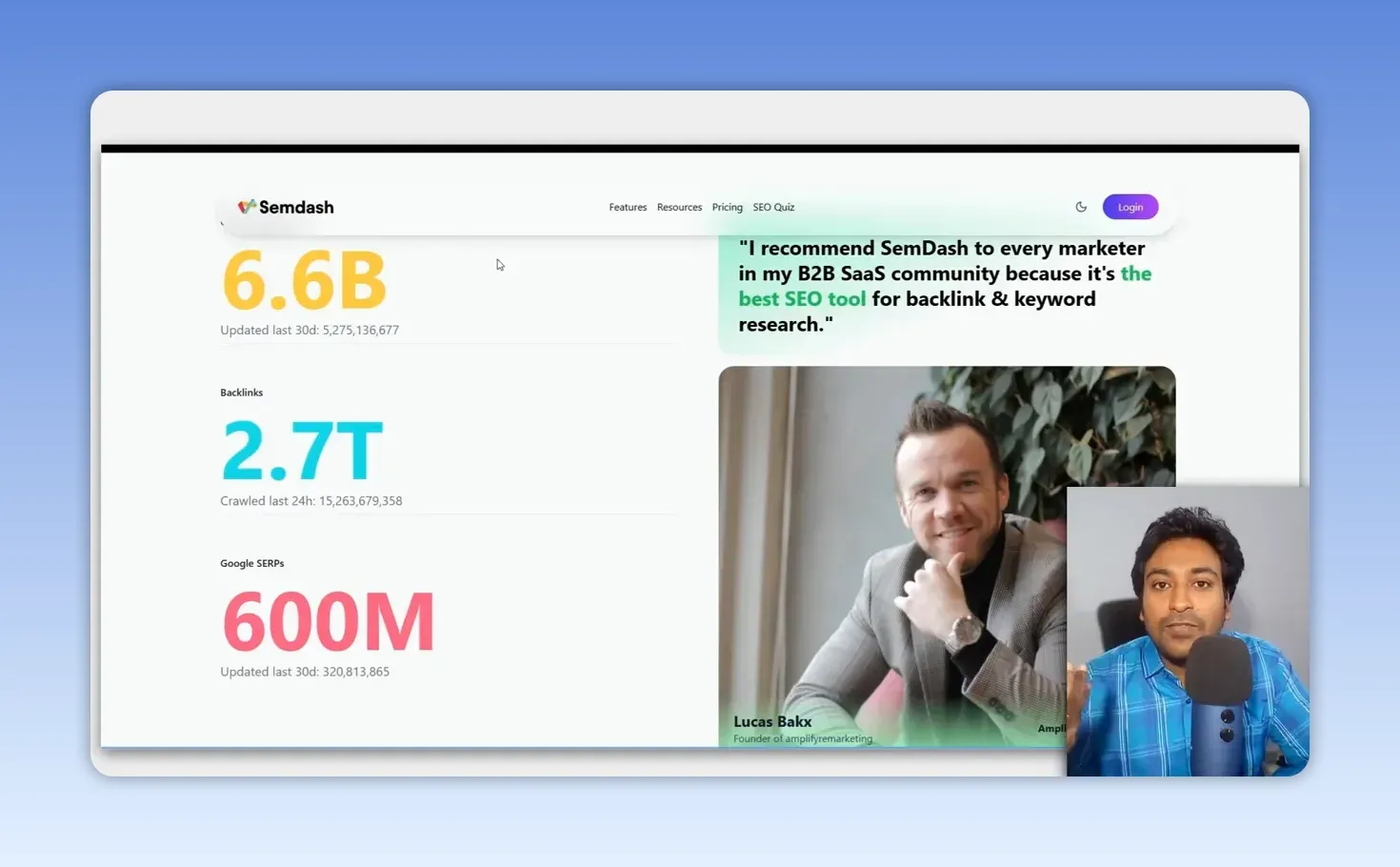
Those are the company’s figures, not something I measured. I can’t say it is on the same level as Semrush or Ahrefs without running the same keywords, backlinks and domains through all three.
What does the Semdash domain overview show?
A quick snapshot of a domain: estimated organic traffic, ranking keywords, backlinks, referring domains, traffic distribution and ranking-position distribution, with traffic and keyword trends a click away. I ran SEO sites I know through it. For a newer site the lack of older data made sense, and I liked getting the overview in one report instead of jumping between tools.
There is also a generate-strategy option. The suggestions were hit or miss and the AI formatting was messy, but a few of them referred to actual rankings and pages rather than generic advice. Treat each one as an idea to investigate, not a task to do without checking.
Can keyword gap and traffic share show my real competitors?
Traffic share can. Keyword gap compares your domain with competitors and lists terms they rank for that you don’t, with filters for volume, competition, intent and keyword. It is most useful for seeing which sections your site might be missing, rather than for collecting more keywords.
Backlink gap works the same way for links a competitor has and you don’t, with filters for new, broken, live and lost links. Broken links can be a starting point for broken-link building, but check the page and the opportunity yourself first. I also hit input errors when I pasted a full URL into some comparison fields, so this part isn’t smooth.
Traffic-share analysis was the one that interested me most. Give it a group of keywords that matter to your business and it shows which domains rank across the whole group. A site ranking for one keyword isn’t always your real competitor; a site with a good average position across the topic is. Look at its keyword count too, because a strong average across a few terms can mislead.
Competitor-domain research then compares domains across keywords and traffic, traffic estimates add time ranges, keyword counts, traffic changes and SERP features, and pages by traffic shows which pages bring a site most of its visits. Together they take you from spotting a competitor to finding its strongest topics and pages.
How useful is Semdash for finding keywords to target?
Useful for discovery. Keyword discovery takes up to 50 seed keywords at once; three seeds returned around 2,500 results in one test. That’s not a huge number, but there is a separate long-tail tool for going deeper, and you can filter by volume, CPC, paid competition and search competition.
My favourite approach is reverse engineering: enter a competitor’s domain and see which keywords already work for them. For ahrefs.com it returned 122,200 keywords, which I could narrow with filters.
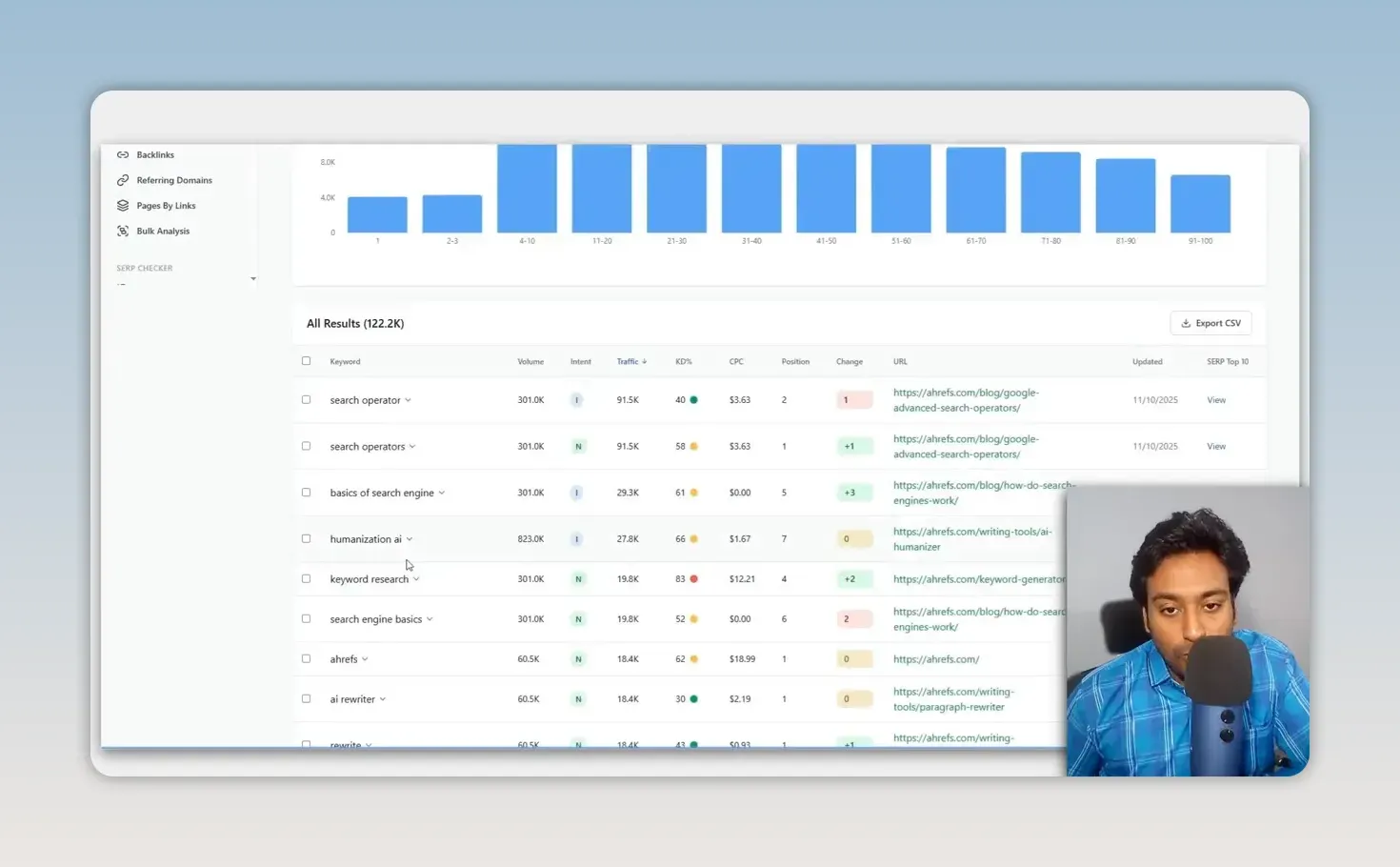
A competitor’s keyword list is only useful once you filter it down to topics that fit your site. My ChatGPT prompts for keyword research cover that step.
For long-tail research I tried a seed like “business SEO” and got related phrases about SEO for business, which I could sort by reported difficulty. This is my biggest warning: don’t trust Semdash’s keyword difficulty blindly. It showed extremely low difficulty for SEO terms I would expect to be competitive. Before choosing a target, look at the search results and compare the score with another source.
People Also Ask lists the questions connected to a topic, which shows what people are trying to solve. The presentation didn’t work well for me and I wanted an easier way to follow related questions; my Answer Socrates review covers a tool built for that. Keyword lists at least let you save ideas in separate buckets.
What can I learn from the backlink research and historical SERPs?
Backlink research shows links, referring domains, pages by links and anchor text, so you can see which of a competitor’s pages attract links and where they come from. Bulk analysis compares several domains at once on backlinks, referring domains and broken links.
It’s good research material, but I’m not sure about every authority value I saw. Domain and page ratings are the tool’s own metrics, so check them before deciding a link is worth chasing. For an Ahrefs Domain Rating to compare against, my free DR checker extension shows it for any link you right-click. The same goes for a referring domain with a lot of links: find out whether it is a good site or just noise.
The historical SERP checker adds another angle. It shows the search results from different dates, with related keywords and other SERP data, so you can see how results changed instead of assuming today’s rankings tell the whole story. It also offers AI analysis, which I didn’t test deeply enough to rely on.
Are the AI search and extra tools ready to use?
Not all of them. The content explorer wasn’t useful in my test: the formatting was poor and too many results looked like backlink spam. The Google Maps data is another way to look at business listings, but not something I needed.
The AI Overview checker showed the response and the elements it referenced. The AI visibility tool appeared to show where a site was cited, which could be valuable, but when I tried to verify an example myself I couldn’t confidently find the same result. I wouldn’t use that citation data for reporting until I had checked it more. My Visby AI review covers a tool built only for AI visibility tracking.
There are also lead-generation and technology-finder tools. Finding businesses by category and location could suit some people, though I use specialised tools for that, and the technology finder needed better targeting. Keyword clustering promises to group terms by theme, but I didn’t have a list ready to test it properly.
Semdash also connects to Google Search Console and shows that data in the platform. I checked it with one of my sites; remember it shows Google data, not traffic from Bing. Every extra search uses credits, and I watched my balance fall while testing, which matters when you judge a plan’s value.
How much does Semdash cost?
On 27 September 2026, Semdash’s pricing page listed three plans, each with a 14-day refund:
| Plan | Monthly | Billed yearly | Credits/month |
|---|---|---|---|
| Starter | $49 | $30/mo ($360/yr) | 1,000 |
| Business | $99 | $60/mo ($720/yr) | 5,000 |
| Elite | $199 | $120/mo ($1,440/yr) | 12,000 |
The lifetime deal I tested around is no longer on sale. The video thumbnail shows it at $69; on 27 September 2026 the Semdash AppSumo listing (affiliate link) was marked sold out, with tiers from $79 for 1,000 credits a month.
What I liked and what I didn’t
What I liked:
- Traffic share shows who competes across a whole topic, not one keyword.
- Competitor-domain keywords and pages by traffic give a fast route to a competitor’s strongest pages.
- Backlink research, backlink gap and bulk analysis cover the usual link work.
- Historical SERPs show how results changed over time.
What I didn’t:
- Keyword difficulty was extremely low for terms that should be competitive.
- Some comparison fields threw errors on full URLs.
- The strategy output and content explorer had poor formatting.
- I couldn’t verify an AI visibility citation myself.
- Every extra search spends credits.
Should I buy Semdash instead of paying for Semrush or Ahrefs?
If you are on a tight budget and don’t want a monthly plan with a big platform, Semdash is worth considering for competitor research, keyword discovery, backlink research and traffic analysis. There is a lot here to use.
But I found bugs, awkward formatting and difficulty scores that need double-checking, and some extra features still need work. My workflow is simple: use Semdash to find opportunities, verify the important metrics, then make the SEO decision. If you want an all-in-one tool that focuses on telling you what to do next, my Morningscore review covers a different approach.
FAQ
Is Semdash a complete alternative to Semrush or Ahrefs?
It covers many of the same research workflows, but I wouldn’t call it an equal replacement without checking its data against those tools on the same domains and keywords.
Can I trust Semdash keyword difficulty?
Not blindly. Some competitive SEO terms showed very low difficulty in my test, so check the search results and verify important scores elsewhere.
Start with the domain overview, traffic share and competitor keywords on a domain you know well. If those numbers look right to you, the rest of the tool is worth your time. The lifetime deal is sold out as I write; if it returns, it will be on the Semdash AppSumo page (affiliate link), and the monthly plans are on Semdash’s pricing page.
Keep reading
You Might Also Like
Bishopi Review: Domain Research Tools and SEO Data Tested
My Bishopi review from a March 2026 test. Dropped domains, valuation and age history held up; keyword ideas, related searches and backlinks fell short.
10 min read

Semrush vs Morningscore: Which SEO Tool Fits Your Business?
Semrush vs Morningscore after using both: keyword depth, backlinks, audits, content tools and price, and which one suits a beginner or an agency.
9 min read

Semrush Review: Every Major Tool Tested, and Is It Worth It?
My Semrush review after using every major tool: keyword research, site audits, backlinks and PPC, what I would skip, pricing, and who should pay.
28 min read