SEO
Future-Proof SEO Strategy: Google, AI Search and Social
How I build a future-proof SEO strategy: Google as the foundation, content AI search can use, and social search where your customers look for a business.

A future-proof SEO strategy is my answer to “is SEO dead?”: don’t build it around one place where people search. Make Google the foundation, write content that AI search tools can understand and use, and make the business easy to find on the social platforms where your customers search. That is what I mean by safe SEO: it works for people today without depending entirely on one channel tomorrow, and it doesn’t mean chasing every new trend.
Prefer to watch? This is lesson 8 of my beginner SEO course.
Why does a future-proof SEO strategy need more than Google?
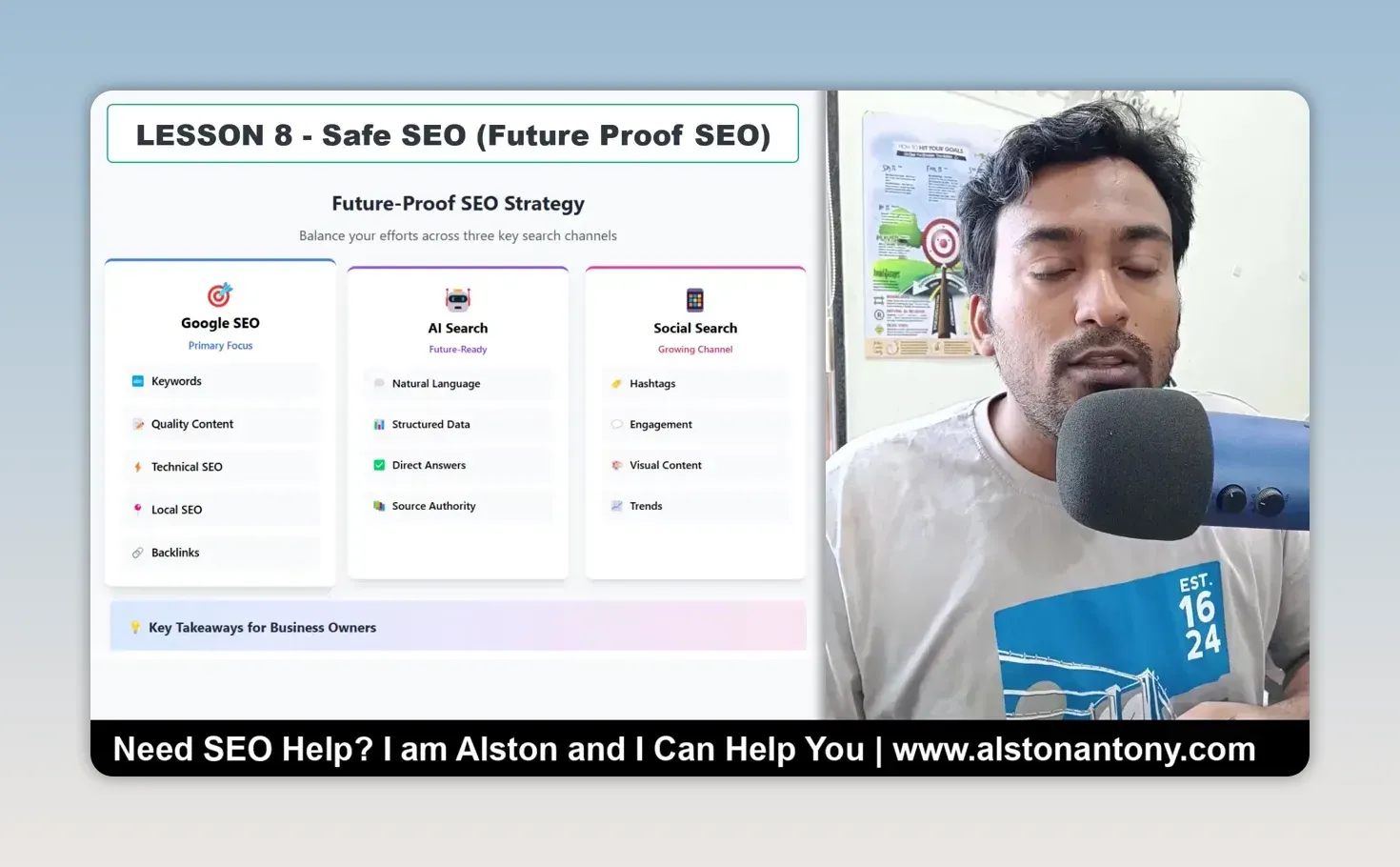
Because search is no longer one platform. Someone might compare services on Google, ask an AI tool a question, or search Instagram for a local business. If you rely on one channel, you miss the people who search in the others. I think of it as three connected areas:
| Channel | Its role | What to focus on |
|---|---|---|
| Google SEO | The primary focus | Keywords, quality content, technical SEO, local SEO, backlinks |
| AI search | Getting ready for it now | Natural language, direct answers, structured data, source authority |
| Social search | A growing channel | Hashtags, engagement, visual content, trends |
Why is Google still the primary focus?
Because many people still search there first, so I wouldn’t skip the fundamentals to chase newer platforms. The Google foundation has five parts:
- The right target keywords. Understand what your customers are looking for and create content that answers it. Keyword research guides the page, but the page still has to be useful to a real person; my ChatGPT prompts for keyword research help with the brainstorming.
- Quality content that genuinely helps the reader.
- Technical SEO, so search engines can access and understand the site.
- Local SEO, for a business that serves a local area: Google Maps and your Google Business Profile. If customers need a service nearby, being found locally matters. My free local SEO GPT helps plan that side.
- Backlinks from relevant sites. Not links for their own sake: create something valuable enough that other people have a reason to reference it.
How do you prepare a site for AI search?
By making your content easy for an AI tool to understand and use when it answers a question. AI search is already happening: people ask ChatGPT, Gemini, Meta AI and Perplexity, which search the web where they can, and Google has its own AI search experiences. I keep Google SEO as the foundation, and then check four things:
- Natural language. Write clearly about the question or problem instead of making the page hard to read.
- Direct answers. Answer the question people came with, instead of making them dig through a long introduction.
- Structured data, where it is appropriate, so search systems understand what the page contains.
- Authority. Give people a reason to trust your site or brand when many other pages cover the same topic.
Take a question related to your service. Does your page answer it directly? Is it clear what your business does? Is the answer helpful enough that someone would choose it over every other page on the subject? Those questions matter for Google as much as for AI search, so I don’t treat AI optimisation as a replacement for good content. My AI SEO guide goes further into how AI answers pick their sources.
Why treat social media search as SEO?
Because people search inside social platforms, and that is different from posting to promote a business. Social media SEO means making a brand, product or service discoverable when someone searches on the platform itself.
My wife often searches on Instagram or Facebook. If she wants a parlour, she may look there rather than on Google or in an AI tool. That’s a simple reminder that customers don’t all follow the same search journey, and a business visible on Google but hard to find on the platform its customers use can miss that opportunity.
Social search means thinking about what people expect to find there: hashtags, engagement, visual content and trends. Photos and videos show what a business offers, and two-way conversation lets people ask questions. The aim isn’t to copy the same web page onto every platform, but to make useful information discoverable in the format each platform suits. My guide to how social media search engines work goes into how those results are chosen.
Before choosing where to put effort, find out where your target customers actually look. A buyer persona helps organise what you know about their interests and where they learn about products and services. Real discussions help too; my BuzzAbout review shows how different the same topic can look on Reddit, YouTube and Instagram. You don’t need to be everywhere just because a platform exists, only in the right places.
How do you put the three together without chasing trends?
In this order:
- Build the Google foundation first: relevant keywords, quality content, technical fixes, and local visibility if the business serves a local area.
- Make sure that content answers questions clearly and supports the brand’s authority for AI search.
- Make the business discoverable through social search where its audience is active.
This isn’t about abandoning one channel when another becomes popular; it’s about avoiding a one-channel approach. Google remains important, AI search is growing, and people also search on social platforms. A future-proof strategy takes all three seriously and keeps the customer at the centre. It also leaves you less exposed when one channel changes, which is what my guide to Google algorithm updates is about.
If the slow start or the lack of guarantees is what worries you, my guide to SEO challenges covers how I handle each one.
So when you plan your next piece of content, don’t only ask how it will rank on Google. Ask whether it answers your customer’s question, and whether they can find your business where they prefer to search.
FAQ
Is Google SEO still important if people use AI search?
Yes. Make Google the primary focus and build a strong foundation there, while preparing your content for AI search and social search.
Do I need to optimise for every search platform?
No. Start with Google, then the AI tools and social platforms where your customers actually search. The goal is to reach the right audience, not to chase every trend.
Keep reading
You Might Also Like
How Social Media Search Engines Work for SEO
How social media search engines work: posts and videos instead of links, fresh content and engagement, discovery intent, and making a business findable.
6 min read

Google Keyword Planner for SEO: Free Ideas From Google
How I use Google Keyword Planner for SEO: set the city, read the search ranges, ignore the Ads competition label, and pull ideas from a competitor's site.
8 min read
How AI Search Engines Work, and What Changes for SEO
How AI search engines work compared with Google: answers with sources, fewer guaranteed clicks, and why a page must be worth opening from a citation.
6 min read