SEO
SEO Challenges: 5 Problems and How to Handle Each
The five SEO challenges every business runs into: slow results, no guarantees, established competitors, bad advice and effort, and what I do about each.

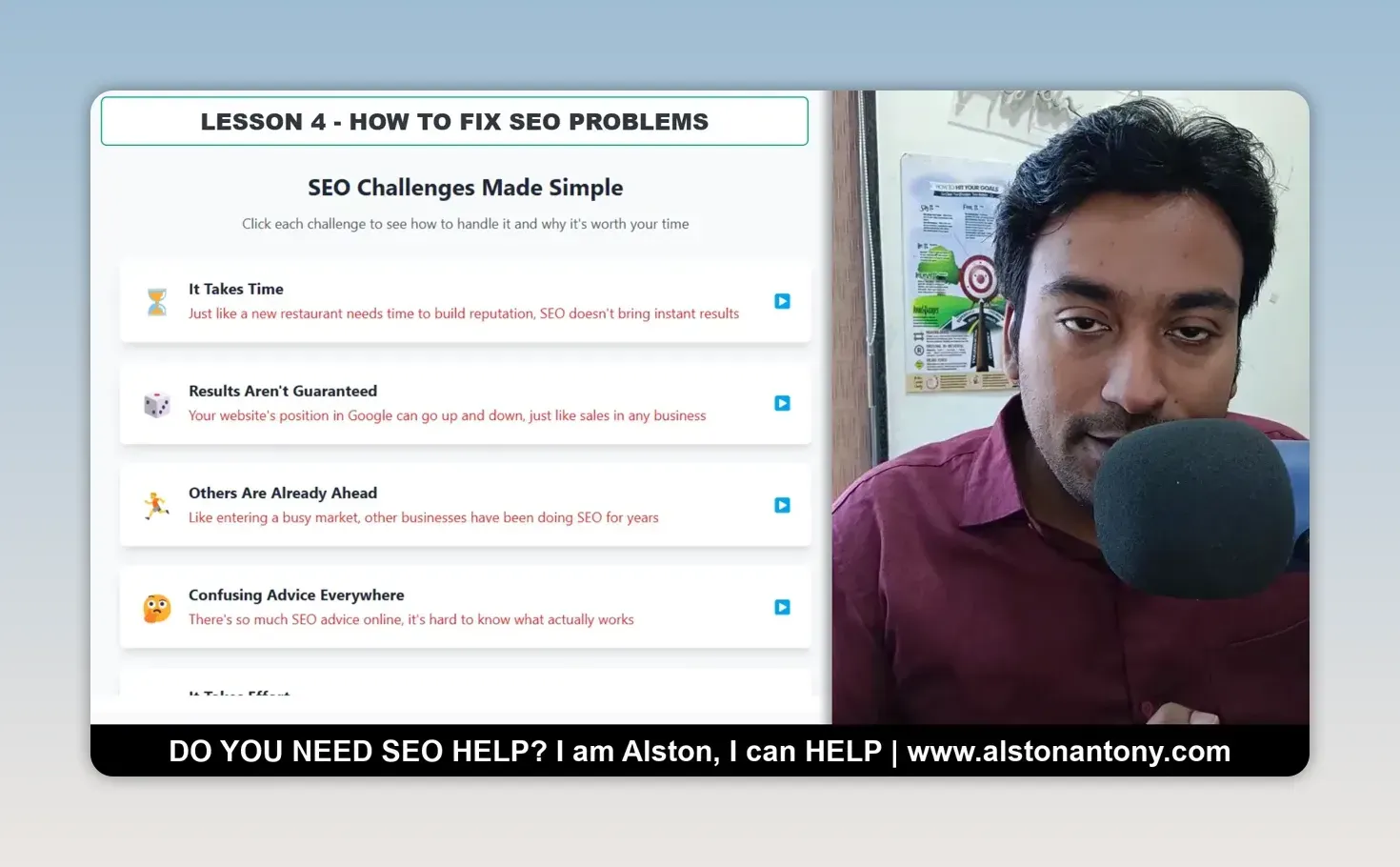
SEO challenges feel huge when you are doing SEO for your own business and can’t yet see the results you expected. There are five I prepare for rather than ignore: it takes time, results aren’t guaranteed, competitors are already ahead, advice is confusing, and it takes effort. None of them goes away, but if you know what to do when each one appears, you can keep going instead of feeling stuck. (If you are still deciding whether SEO is worth the investment, start with the disadvantages of SEO.) The same applies if SEO is your career, because a client will ask why it takes so long, or whether you can guarantee a ranking, and you should have an honest answer ready.
Prefer to watch? This is lesson 4 of my beginner SEO course.
What are the five SEO challenges?
| Challenge | Why it happens | What I do |
|---|---|---|
| It takes time | Like a new restaurant, a site has to earn trust before people come | Plan long term and notice the small wins |
| Results aren’t guaranteed | Google is a third party; rankings go up and down | Run paid ads in parallel if needed, or target long-tail keywords |
| Others are already ahead | Competitors have been doing SEO for years | Find a unique angle and a part of the market you can serve better |
| Confusing advice | There is far more SEO advice online than is worth following | Pick a few trusted sources and learn the fundamentals |
| It takes effort | SEO feels like one enormous job | Break it into small tasks and tick them off |
How do you stay motivated when SEO takes time?
Treat it as a long-term plan and watch the small gains. Think about opening a restaurant: you can’t open the doors and expect everyone to know you, trust you and walk in on the first day. You plan the business, prepare what you offer, make the place welcoming, market it and build a reputation, and customers have to try it and like it. All of that takes time.
SEO works the same way. I improve the website small by small so it becomes more useful and attracts the right people over time. When I only ask “how long will this take?”, the challenge feels bigger; when I also look at the small wins, the work makes sense.
A small win might be a page moving up for a relevant search, or a query bringing a few people to the site. It isn’t the final result, but it tells you something about what you are doing, so you can learn from it and keep going.
What if results aren’t guaranteed but you need customers now?
Run another channel in parallel, or aim at smaller, more specific searches. I can’t guarantee SEO results, because Google is a third party and I don’t control its rankings. I would rather be clear about that with a business owner than pretend otherwise. When rankings do move, my guide to Google algorithm updates explains why.
If the business needs customers while SEO is still developing and there is budget, consider social media advertising or Google Ads pay-per-click campaigns to bring people in sooner. The trade-off is that you pay for every click or impression, and the traffic stops when the spending does. So I don’t treat ads and SEO as either-or: the ads can keep customers coming while SEO builds, and if SEO later brings enough of the right people, the business may be able to rely less on the ads. I can’t promise when that will happen, only why doing both helps.
If you’d rather focus on search without ads, stop going after only the toughest, broadest keyword and look for a more specific, lower-competition long-tail keyword. Instead of only chasing “best lawyer” in a city, a lawyer might target a particular type of legal help in that city. The more specific search can still come from a real customer.
That isn’t an automatic easy ranking. Check that the phrase is relevant and that you can write a useful page for it. But when a smaller keyword starts bringing results, you can look at what you did and what happened, and make better decisions next time. My Google Keyword Planner guide shows a free way to find those long-tail ideas for a specific city.
How do you compete with businesses that have done SEO for years?
With an angle of your own, not a copy of theirs. Becoming a copy of an established competitor gives nobody a reason to choose you, so find the competitive advantage you can bring out clearly. What does the business do differently? Which customer needs does it understand well? What have competitors missed?
Reflect those answers in the pages you create and the searches you target. You can still work towards the bigger terms, but in parallel focus on a smaller part of the market where the business has something useful to say.
A buyer persona helps here. With a clearer idea of who you want to reach, you stop asking only “what are my competitors ranking for?” and start asking “what is this customer looking for, and how can I help?” That gives the SEO work a direction of its own. If you want to hear how customers describe their problems in their own words, my BuzzAbout review shows one way to research that.
How do you avoid bad or outdated SEO advice?
Choose a few sources you trust and stay with the fundamentals. Not every piece of SEO advice online deserves your time, and I don’t recommend following every influencer or trying every idea because it sounds exciting.
Look at whether someone explains what they do clearly, whether they can show results, and whether their advice feels genuine rather than chasing the next shiny object. You may connect with different teachers than I do, and that’s fine; do your research and decide. For guidance from the search engine itself, Google’s SEO Starter Guide is a useful reference, and my guide to how search engines work covers the basics everything else builds on. Learn the fundamentals and stay on the road, instead of changing direction every time you hear a new claim.
How do you manage the effort without feeling overwhelmed?
Break SEO into small tasks and tick them off. Everything in business takes effort: running it, marketing it, and SEO too. What makes SEO feel hard is thinking of it as one enormous job.
I always keep a diary near me. There are to-do apps, but I like writing things down. When I have work to do, I split it into smaller categories and tick each task off when it’s done, which feels good. When I look back after two or three weeks, I can see everything I finished instead of remembering only what’s left.
Do the same with your own SEO: pick one page and one keyword, decide what needs improving, and complete one manageable task at a time. Don’t judge the whole plan by what you finished today; look at the work adding up and the value that page may keep bringing.
Why is SEO still worth doing?
Because it brings people who are already searching for what you offer. The challenges are real: it takes time, rankings are uncertain, competitors exist, advice is confusing and the work takes effort.
But unlike a paid campaign, an improved page can keep attracting relevant traffic after the work that created it is done, even with only light upkeep. That doesn’t mean you stop maintaining the site, or that every page will succeed; it means the effort has a chance to keep paying back. For how SEO fits alongside AI search and social search, see my future-proof SEO strategy.
Be patient about time, honest about uncertainty, specific about whom you want to reach, careful about whose advice you follow, and practical about the work you take on each day. Once you know what to do when each challenge appears, SEO becomes much easier to keep doing.
FAQ
Can anyone guarantee SEO results?
No. Google decides the rankings, so nobody outside it can guarantee a position. I would rather be clear about that with a client from the start.
Should I run ads while waiting for SEO to work?
If the business needs customers now and has the budget, running social or Google ads in parallel can help. The traffic stops when you stop paying, while a page that ranks can keep bringing visitors.
Keep reading
You Might Also Like
Disadvantages of SEO: 5 Risks to Know Before You Start
The disadvantages of SEO before you invest or hire: it is slow, nobody can guarantee rankings, competitors are ahead and bad advice can set you back.
7 min read

Advantages of SEO: 5 Benefits for Your Business
The advantages of SEO for a business: being found by targeted customers, traffic with no per-click cost, a better site, brand trust and long-term growth.
8 min read

Future-Proof SEO Strategy: Google, AI Search and Social
How I build a future-proof SEO strategy: Google as the foundation, content AI search can use, and social search where your customers look for a business.
6 min read