SEO
Advantages of SEO: 5 Benefits for Your Business
The advantages of SEO for a business: being found by targeted customers, traffic with no per-click cost, a better site, brand trust and long-term growth.

The advantages of SEO are easier to see when you stop thinking only about rankings and start thinking about what those rankings do for a business. SEO helps your website get found by the right people, brings targeted traffic without paying for every click, makes your website easier to use, builds trust in your brand and supports long-term growth. I’ll go through each benefit with a practical example. If you are new to the subject, start with what SEO is.
Benefits are only half the picture. Before you put time into SEO, read the disadvantages of SEO too, so you start with clear expectations.
Prefer to watch? This is lesson 2 of my beginner SEO course.
What are the five advantages of SEO?
| Advantage | What it means | The catch |
|---|---|---|
| Get found online | You appear when targeted customers search for what you offer | A top position isn’t automatic |
| Traffic without paying per click | No charge from the search engine for each organic visit | It still costs time, effort and sometimes tools |
| Happy visitors, happy business | A well-organised site is easier for people to use | You have to keep improving it |
| Build trust in your brand | Being found easily creates a strong first impression | A high position isn’t proof you are the best |
| Long-term growth | Pages can keep bringing customers after the initial work | Rankings aren’t guaranteed to last |
How does SEO help your business get found by targeted customers?
It moves your shop onto a busy street. Think of your business as a shop on a quiet street, in a remote place, or even in a different country from the people you want to reach. Now imagine moving it onto a popular street where the people walking past are interested in what you sell.
The search engine is that virtual street. When someone searches for something relevant to your business, your goal is to have your website appear where they can find it. The important part is that these are targeted customers: they may be learning about a service, comparing options or ready to buy. You aren’t trying to attract anybody who happens to pass by; you are trying to appear for the searches your potential customers actually use.
A top position isn’t automatic. You first need to understand what people search for and which searches matter to your business, which my ChatGPT prompts for keyword research and my Google Keyword Planner guide cover. But the first benefit is simple: when a customer looks for something you offer, SEO gives your website a chance to be found.
Why does SEO bring traffic without paying for every visitor?
Because the search engine doesn’t charge for organic clicks. Many marketing methods mean paying to put your message in front of people: a pay-per-click campaign, a social media ad, printed leaflets or a TV advertisement. They can be useful, but there is usually a direct cost to keep them running.
With SEO, you work on your website and its visibility, and if a relevant page ranks, people can visit through that result without a per-click charge.
I don’t call SEO completely free, though. You can do much of the work yourself, but it takes time and effort, and you may decide to pay for tools or services. What changes is where the investment goes: into doing the SEO work, rather than paying for every visitor.
That matters most when the traffic is targeted. Someone who arrives after searching for your product or service already has a reason to be interested, which is why I don’t look at traffic numbers alone. I want visitors who are looking for what the business provides.
How does SEO make your website better for visitors?
By organising it for people, not only for search engines. Modern SEO is also about improving the experience for the person who arrives. I call this benefit “happy visitors, happy business”.
Imagine walking into a shop where everything is neatly arranged: products in sensible categories, correct price tags, and you can quickly find what you came for. You would feel comfortable staying. Now imagine the opposite, with nothing organised, wrong prices, and one product taking far too long to find. Even if the shop has what you need, you leave with a bad impression.
A website works the same way. When I improve its organisation and make information easier to find, I’m not only working towards search visibility; I’m helping customers see what is available and reach what they need. Attracting a visitor matters, but so does the experience once they arrive. Google’s SEO Starter Guide is a useful reference for making content understandable to both people and search engines.
Why can appearing in search results build trust in your brand?
Because being easy to find creates a strong first impression. Suppose you search for “best lawyer in Chennai”. When a lawyer’s website appears prominently in the results, you may be more inclined to look at that business, and you might start to think the lawyer is established or experienced simply because you found them so easily.
I see the same thing when people search for an SEO expert in a particular place. If my website appears for a relevant search, it gives someone a way to discover my work and decide whether I can help them.
Be careful with this one: a high position isn’t proof that a business is the best, or that every claim on its website is true. Search visibility creates the first impression; the website, the service and the customer’s experience still have to back it up. For a business otherwise known only to people nearby, being found for a relevant search can be the start of a relationship with a new customer.
Why is SEO an investment in long-term growth?
Because it grows like a tree. This is the benefit I most want my students and customers to remember: SEO isn’t a one-off small task. You plant the seed, then put in the work to help it grow. You don’t plant it in the morning and expect a tree full of fruit by the evening; the early stage needs effort and patience, and as the tree grows it starts to give you fruit over time.
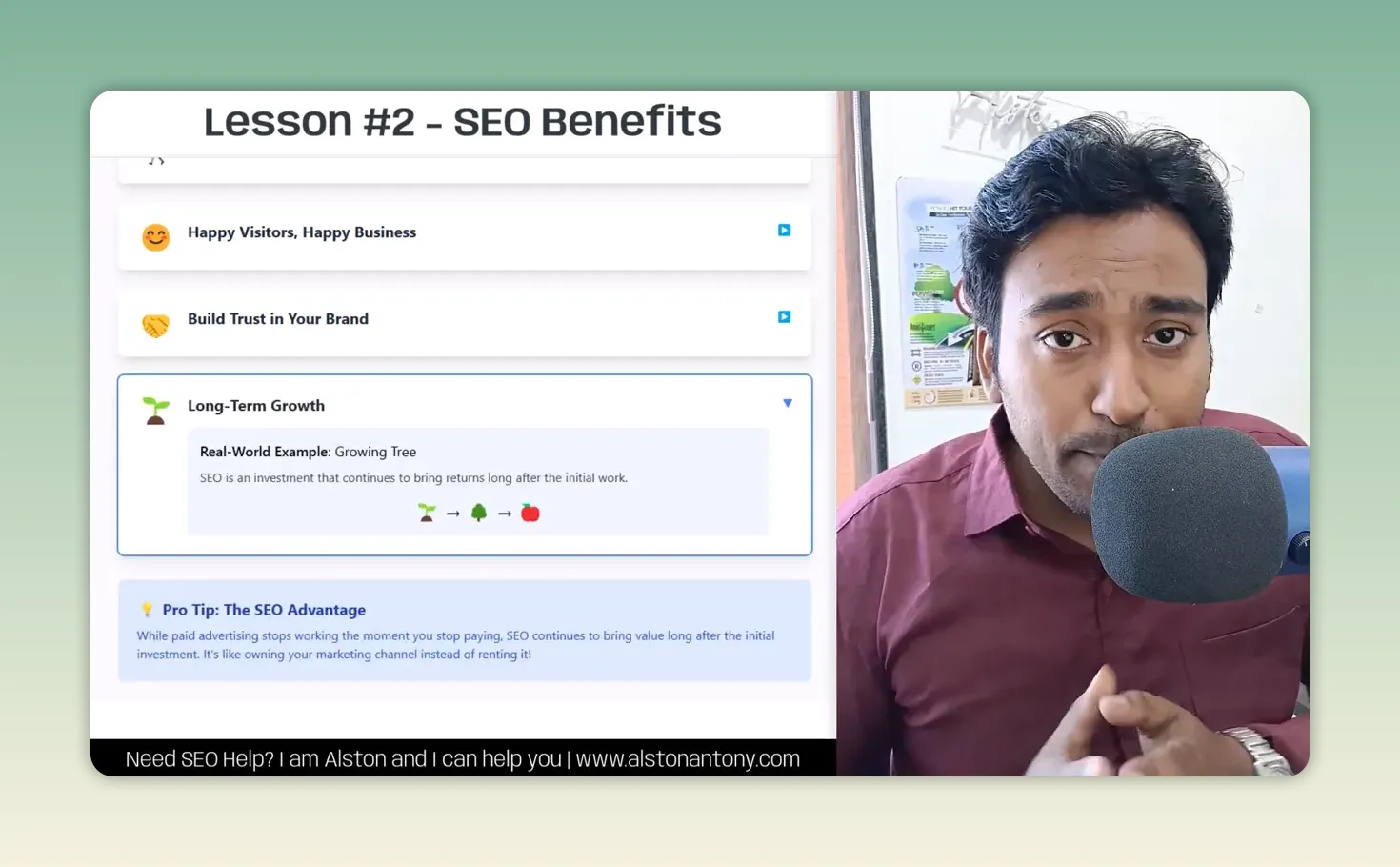
SEO follows the same pattern. You do the initial work on your website, build useful pages and keep improving them. As the site earns visibility for relevant searches, those pages can keep bringing in potential customers after the first round of work is done. You may still need to maintain and improve them, but you are building something that lasts beyond a single campaign.
A TV ad, a newspaper placement or a pay-per-click campaign generally stops appearing when you stop paying. As the slide puts it, SEO is like owning your marketing channel instead of renting it. SEO results aren’t guaranteed to stay forever, but the work you have done on your website doesn’t vanish because you pause spending on ads. So when someone asks me for the biggest advantage of SEO, that’s my answer: you are investing in a process that can keep helping your business after the initial work.
What should you remember before investing time in SEO?
All five benefits together. Getting found online brings the right people to your website. Organic search can bring traffic without a charge for every click. A better website makes those visits more useful. Search visibility helps people discover your brand and begin to trust it. And the work you put in today can support growth later.
At the same time, never treat SEO as a promise of instant results or permanent rankings. It takes effort, and it has limitations as well as benefits; my guide to SEO challenges covers how I handle them. Start by understanding your customers’ searches, make your website useful to them, and treat SEO as a long-term investment rather than a quick task to tick off a list. If you want to know what happens behind the results first, see how search engines work.
FAQ
Is SEO traffic completely free?
You don’t pay a search engine for each click on an organic result, but doing SEO takes time and effort. You may also choose to pay for tools or services.
Will SEO keep bringing customers if I stop working on it?
A page can keep attracting visitors after the initial work, but results aren’t guaranteed to last. I think of SEO as a long-term investment that may still need maintenance and improvement.
Keep reading
You Might Also Like
SEO Challenges: 5 Problems and How to Handle Each
The five SEO challenges every business runs into: slow results, no guarantees, established competitors, bad advice and effort, and what I do about each.
8 min read
Disadvantages of SEO: 5 Risks to Know Before You Start
The disadvantages of SEO before you invest or hire: it is slow, nobody can guarantee rankings, competitors are ahead and bad advice can set you back.
7 min read
Future-Proof SEO Strategy: Google, AI Search and Social
How I build a future-proof SEO strategy: Google as the foundation, content AI search can use, and social search where your customers look for a business.
6 min read