SEO
What Is SEO? A Simple Explanation for Beginners
What is SEO? Search engine optimisation explained with a 100-floor shopping mall: how it helps target customers find your page before they go elsewhere.

What is SEO? SEO, or search engine optimisation, is the process of improving a website, a web page or another online property so it has a better chance of appearing prominently when your target customers search for something relevant. I don’t want you to memorise that from a textbook, though. I want you to understand it well enough to explain it in your own words and decide what it means for your business, so let’s forget about Google for a moment and picture a shopping mall.
Prefer to watch? This is lesson 1 of my beginner SEO course.
How does a 100-floor shopping mall explain SEO?
Imagine a shopping mall with 100 floors. Each floor has 10 shops, and every shop sells dresses, talks about dresses or offers something related to them. A person enters because they want to buy a dress, learn about dresses or solve some other dress-related need.
There is no lift. The person starts on the ground floor and walks from one shop to the next, and as soon as they find what they need, they leave. They have no reason to climb another 20, 50 or 100 floors.
Now say you own a dress shop on the 50th floor. You might have a better deal or a better-quality product than the shops below you, but if the person finds a suitable dress on the ground floor, they will never meet you. You missed the sale not because your product was worse, but because your shop was too hard to find.
That’s the idea to remember: SEO is like bringing your shop down from a higher floor to the ground floor, where people find it early in their search.
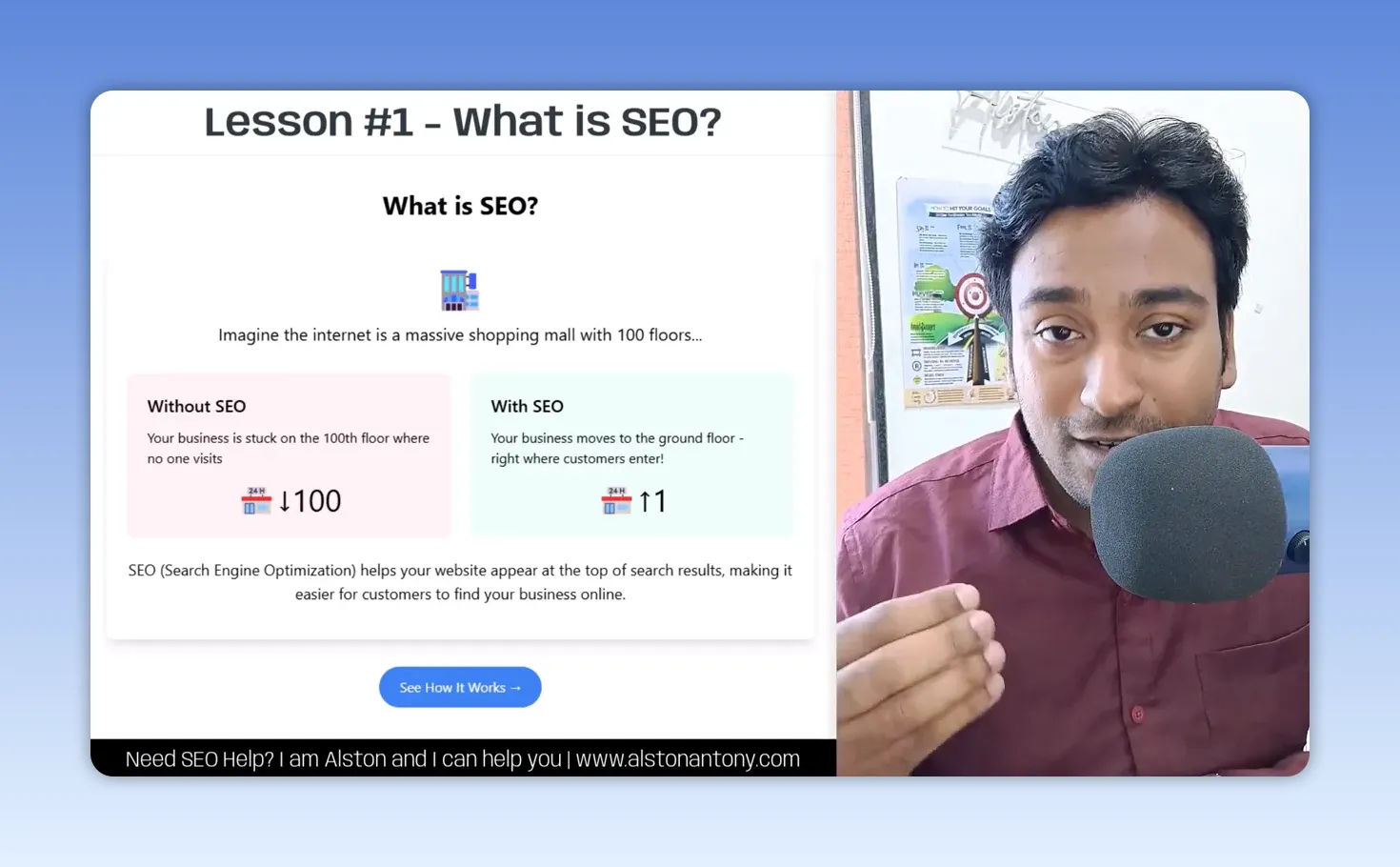
A search results page isn’t literally a shopping mall, but the problem is the same: if the right people can’t find your business before their need is met elsewhere, they may never discover what you offer.
| Without SEO | With SEO | |
|---|---|---|
| In the mall | Your shop is on a high floor few people reach | Your shop is near the ground floor, where people enter |
| In search results | Your page is buried beneath other results | Your page appears early for relevant searches |
| What the customer does | Finds what they need elsewhere and leaves | Has a chance to find you while still looking |
What is search engine optimisation on a real search engine?
It’s connecting a person’s search with a page that meets their need. On Google or Bing, a person types a question, product or service into the search box, and the search engine examines the information available and shows the results it considers relevant. My job with SEO is to help the right page from my business become one of those visible, useful results. My guide to how search engines work explains what happens behind that search box.
I also think about search more broadly. People look for information through AI tools such as ChatGPT and Gemini, and they search inside social platforms such as Facebook and Instagram. Each works differently, so I don’t treat them all like Google (see how AI search engines work and how social media search engines work). The common question stays the same: when my target customer looks for what I offer, can they find me?
For more detail on how Google approaches visibility, read Google’s SEO Starter Guide. But if you are just starting, don’t let the technical terms hide the simple purpose.
Why does appearing lower in the search results matter?
Because people leave before they reach you. Go back to the dress shop: your business can exist, your products can be good and your prices attractive, and none of that helps the person who leaves the mall before reaching your floor. The same happens in search. Your website may be there but buried behind many other pages, and someone looking for your service finds an answer or chooses another business first.
That doesn’t mean the only goal is to be number one for every word. First I need to understand what my target customer is searching for, because a high position for a search unrelated to my business doesn’t solve anything. I want to be visible when the person has a need I can actually meet. To find those searches, my ChatGPT prompts for keyword research and my Google Keyword Planner guide are good starting points.
How would I use SEO for “SEO expert Coimbatore”?
By improving the one page that answers that search. Suppose my business sells SEO services and I want to reach people in Coimbatore. Searches I would care about include “SEO expert in Coimbatore” and “SEO services in Coimbatore”.
When someone types one of those into Google, I’d love them to find my website near the top. But if my page is far down the results, they see other websites first, visit one of them and perhaps get the help they need there. My page never gets a chance.
So I work on SEO with a specific purpose: improve the relevant page and help it move from a low position towards a visible one for that search. The search phrase tells me what the potential customer wants, and my page should make it clear that I offer exactly that.
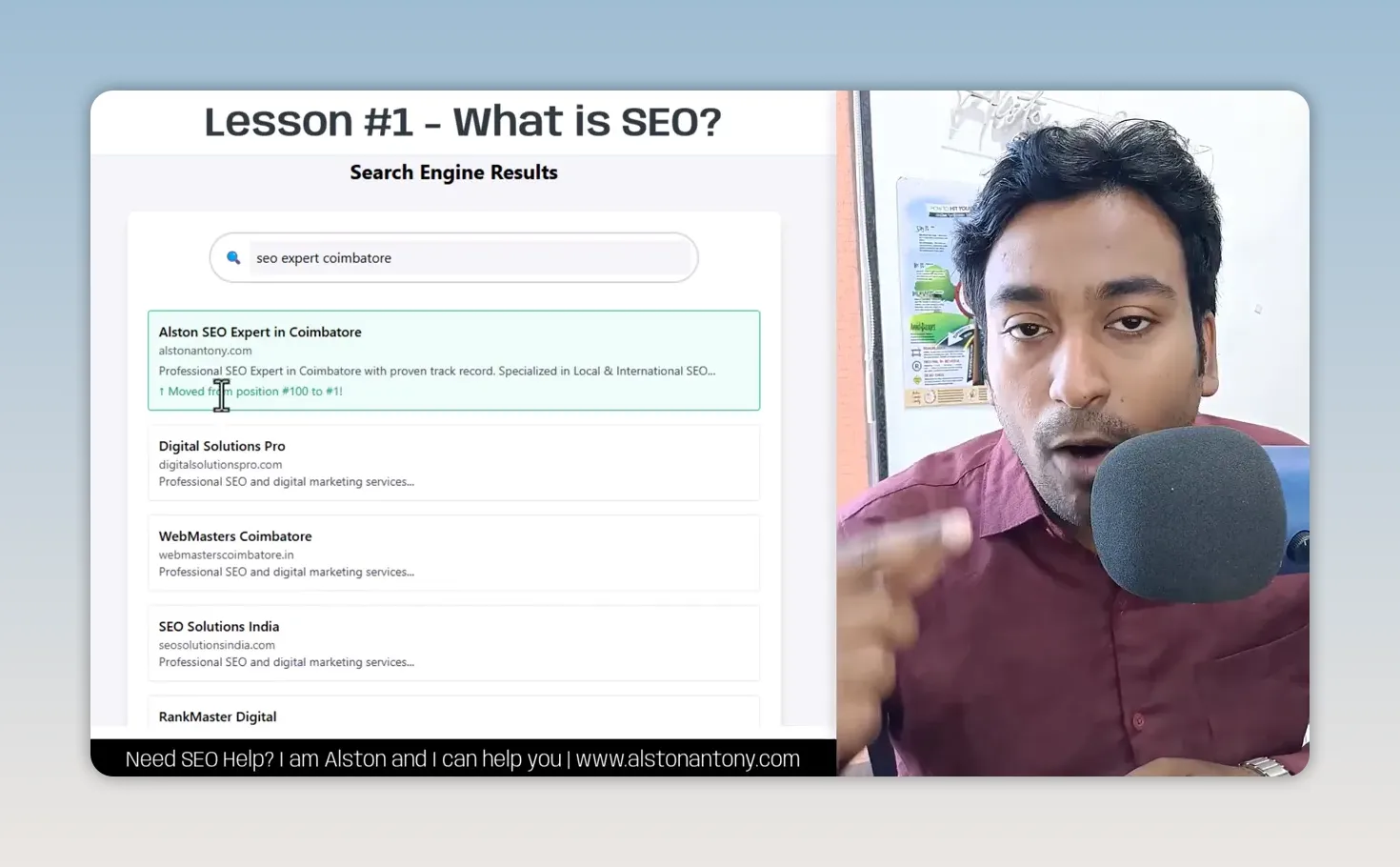
The slide is an illustration of the goal, not a screenshot of a real ranking. I can’t promise that SEO will put every page in first position, because other pages compete for the same search (my guide to SEO challenges covers that). What I can do is understand the search, improve the page and work towards making my business easier to find for the people I want to help.
What happens after SEO brings the right person to your website?
You still have to win them over. Reaching a higher position isn’t the final step. When a person searching for SEO services arrives on my website, I still need to show them that I understand their need and can help. A visit is an opportunity to gain a customer; it doesn’t automatically become a sale.
That’s why I describe SEO as more than moving a page upward. I’m trying to put my website in front of my target customer when they search for something relevant, and visibility matters because it gives that customer a chance to meet my business in the first place.
The simplest way I remember it: if my customer is searching, I don’t want my shop hidden on the 100th floor. I want my relevant page to be easy to find while they are still looking. From there, the next lessons cover the advantages of SEO and the disadvantages of SEO.
FAQ
What does SEO stand for?
SEO stands for search engine optimisation. I use it to describe the process of improving an online property’s visibility for relevant searches.
Does SEO guarantee the number one position?
No. A top position is a goal, not a guarantee. SEO means improving a relevant page so it has a better chance of being found when target customers search.
Keep reading
You Might Also Like
SEO Challenges: 5 Problems and How to Handle Each
The five SEO challenges every business runs into: slow results, no guarantees, established competitors, bad advice and effort, and what I do about each.
8 min read
Disadvantages of SEO: 5 Risks to Know Before You Start
The disadvantages of SEO before you invest or hire: it is slow, nobody can guarantee rankings, competitors are ahead and bad advice can set you back.
7 min read

Advantages of SEO: 5 Benefits for Your Business
The advantages of SEO for a business: being found by targeted customers, traffic with no per-click cost, a better site, brand trust and long-term growth.
8 min read